HPLC Method for Analysis of Uric Acid on BIST B+ Column by SIELC Technologies
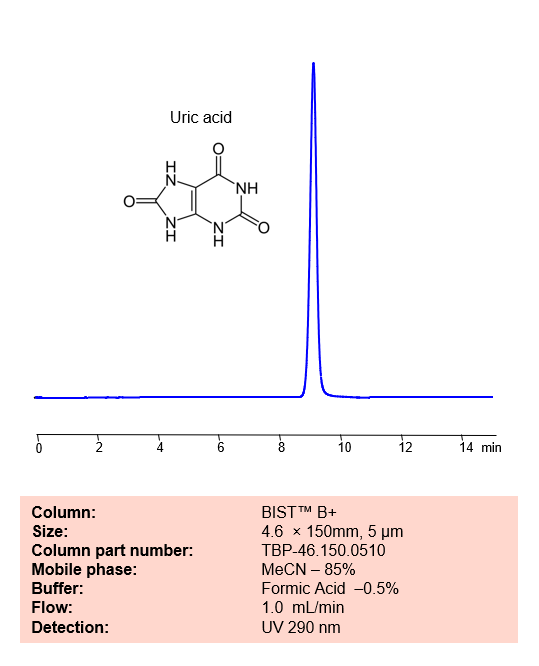
Uric acid is a waste product that’s produced when the body breaks down purines, substances found in foods and drinks like liver, anchovies, mackerel, dried beans, peas, and beer. It is normally excreted from the body in urine. However, if the body produces too much uric acid or doesn’t excrete enough of it, it can build up in the blood and potentially lead to health problems such as gout and kidney stones.
Uric acid can be retained and analyzed using an isocratic analytical method on a BIST B+ column. The simple mobile phase for this method comprises water, acetonitrile (MeCN), and formic acid as an ionic modifier. The analytical method can be monitored with UV detection at 260 nm, an Evaporative Light Scattering Detector (ELSD), or any other evaporative detection method such as Charged Aerosol Detection (CAD) or Electrospray Ionization Mass Spectrometry (ESI-MS)
Methodenparameter
| Column | BIST B+, 4.6 x 150 mm, 5 µm, 100 Å, dual ended |
|---|---|
| Mobile Phase | MeCN85% |
| Buffer | FA – 0.5% |
| Flow Rate | 1.0 mL/min |
| Detection | UV 290 nm |