HPLC Method for Analysis of Quinoline Yellow WS on BIST A+ Column by SIELC Technologies
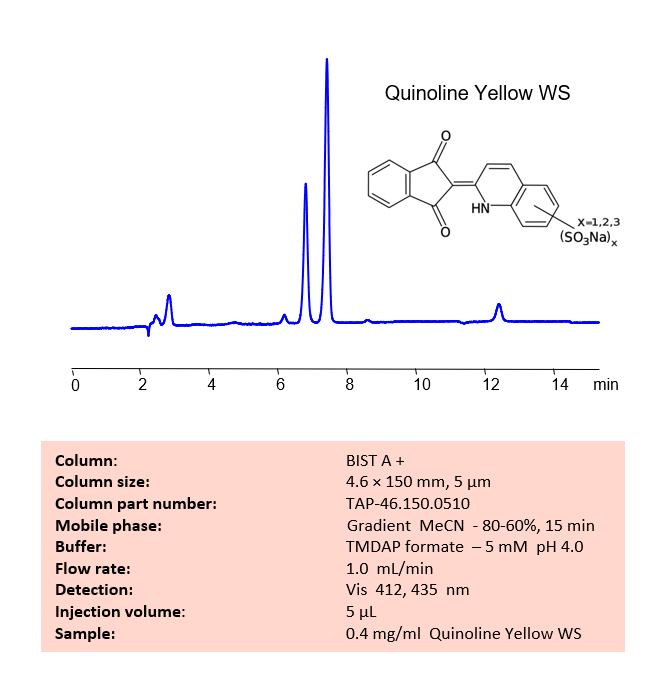
Quinoline Yellow WS ( E104 , D&C Yellow 10 ) is a mixture of 3 different derivatives of Quinoline Yellow SS, consisting of monosulfonates, disulfonates, and trisulfonates. The dye is typically neon-yellow (yellow with a hint of green). It has the chemical formula C18H13NO5/8/11 S1/2/3 Na1/2/3 . The “WS” in it’s title stands in for “water-soluble.” It is used in foods, decorations, and coatings.
Using SIELC’s newly introduced BIST™ method, Quinoline Yellow WS can be retained and separated into its component compounds easily on a negatively-charged, cation-exchange BIST A+ column. There are two keys to this retention method: 1) a multi-charged, positive buffer, such as N,N,N’,N’-Tetramethyl-1,3-propanediamine (TMDAP), which acts as a bridge, linking the negatively-charged anion analytes to the negatively-charged column surface and 2) a mobile phase consisting mostly of organic solvent (such as MeCN) to minimize the formation of a solvation layer around the charged analytes. Other positively-charged buffers that can generate BIST™ include DMP, Calcium acetate, and Magnesium acetate. Using this new and unique analysis method, [comounds] can be retained and separated with high selectivity and great peak shape. This method can be detected and is compatible with ELSD, CAD, and Mass Spectrometry (LC-MS).
Methodenparameter
| Column | BIST A+, 4.6 x 150 mm, 5 µm, 100 Å, dual ended |
|---|---|
| Mobile Phase | Gr MeCN – 80-60%, 15 min |
| Buffer | TMDAP formate – 5 mM pH 4.0 |
| Flow Rate | 1.0 mL/min |
| Detection | VIS412nm |