HPLC Method for Analysis of Glucose 6-phosphate and Fructose 6-phosphate on Newcrom B Column
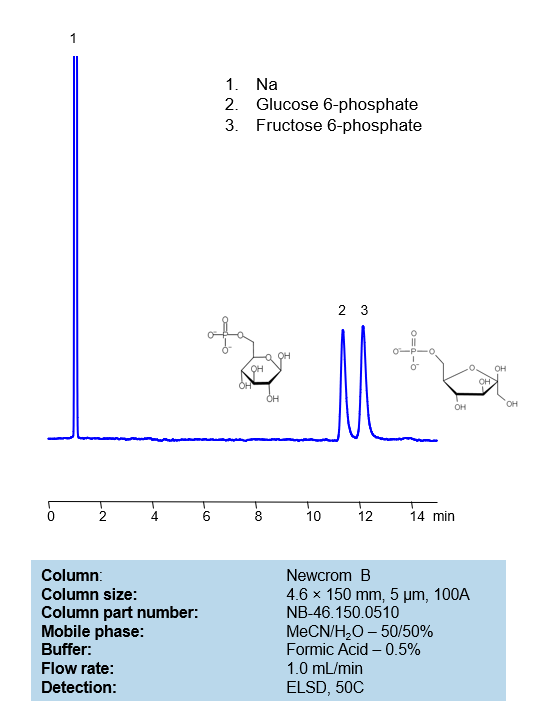
Glucose 6-phosphate , also known as Robison ester , is a glucose sugar with the chemical formula C6H13O9P . It is a derivative of glucose that forms during cellular metabolism. It is also produced during the breakdown of glycogen polymers.
Glucose 6-phosphate is first formed by cells to ensure it does not diffuse out of the cell, and then through the process of glycolysis, it’s isomerized into Fructose 6-phosphate .
Fructose 6-phosphate , known as Neuberg ester , is a derivatives of fructose that forms during cellular metabolism with the chemical formula C6H13O9P . It’s alternate name comes from the biochemist, Carl Neuberg, who discovered that the compound was produced during hydrolysis of fructose 2,6-biphosphate.
These 2 phosphorylated sugars can be retained, separated, and analyzed on a mixed-mode Newcrom B column with a mobile phase consisting of water, Acetonitrile (MeCN), and Formic acid (FA). This analytical method can be analyzed via any evaporative detector, including ELSD, CAD, and ESI-MS with high resolution and peak symmetry.
Methodenparameter
| Column | Newcrom B, 4.6 x 150 mm, 5 µm, 100 Å, dual ended |
|---|---|
| Mobile Phase | MeCN – 50% |
| Buffer | Formic Acid – 0.5% |
| Flow Rate | 1.0 mL/min |
| Detection | ELSD, 50C |