HPLC Separation of Haloacetic acids on Newcrom BH Column
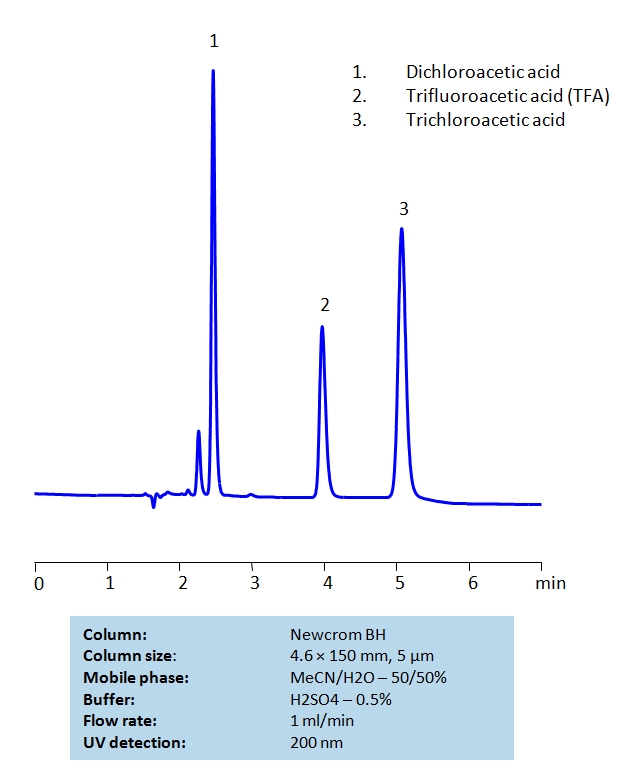
High Performance Liquid Chromatography (HPLC) Method for Analysis of Trichloroacetic acid , Dichloroacetic acid , TFA (Trifluoroacetic Acid) .
Dichloroacetic Acid (DCA) , also known as bichloroacetic acid (BCA), is a highly corrosive acid with the chemical formula C2H2Cl2O2 . While it is used in personal care items and disinfectants, it is a known carcinogen. Despite that, research shows that it may be a plausible treatment for certain cancers.
Trifluoroacetic Acid (TFA) is a synthetic organofluorine acid with the chemical formula C2HF3O2 . It is corrosive and toxic to aquatic life and mammals, causing severe irritation and burns to skin, eyes, and the respiratory tract. Not only that, TFA is also highly mobile and persistent, leading to high retention of it in soil and water. Determination of it’s threat level on the environmental and health levels are still ongoing.
Trichloroacetic Acid (TCA) , also known as trichloroethanoic acid, is an analogue of acetic acid with the chemical formula C2HCl3O2 . It is often used as a skin peeling treatment to exfoliate damaged skin and encourage collagen production. In laboratory research, it is used for precipitating proteins and to extract and prepare standards for ascorbic acid (Vitamin C) assays.
Trichloroacetic acid , Dichloroacetic acid , TFA (Trifluoroacetic Acid) can be retained and analyzed using the Newcrom BH stationary phase column. The analysis utilizes an isocratic method with a simple mobile phase consisting of water and acetonitrile (MeCN) with a [buffer] buffer. Detection is performed using UV.
Methodenparameter
| Column | Newcrom BH, 4.6 x 150 mm, 5 µm, 100 Å, dual ended |
|---|---|
| Mobile Phase | MeCN/H2O – 50/50% |
| Buffer | H2SO4 – 0.5% |
| Flow Rate | 1.0 mL/min |
| Detection | UV 200 nm |