HPLC-MS Method for Analysis of Hydroxyproline, Creatine, and Creatinine on Newcrom AH Column
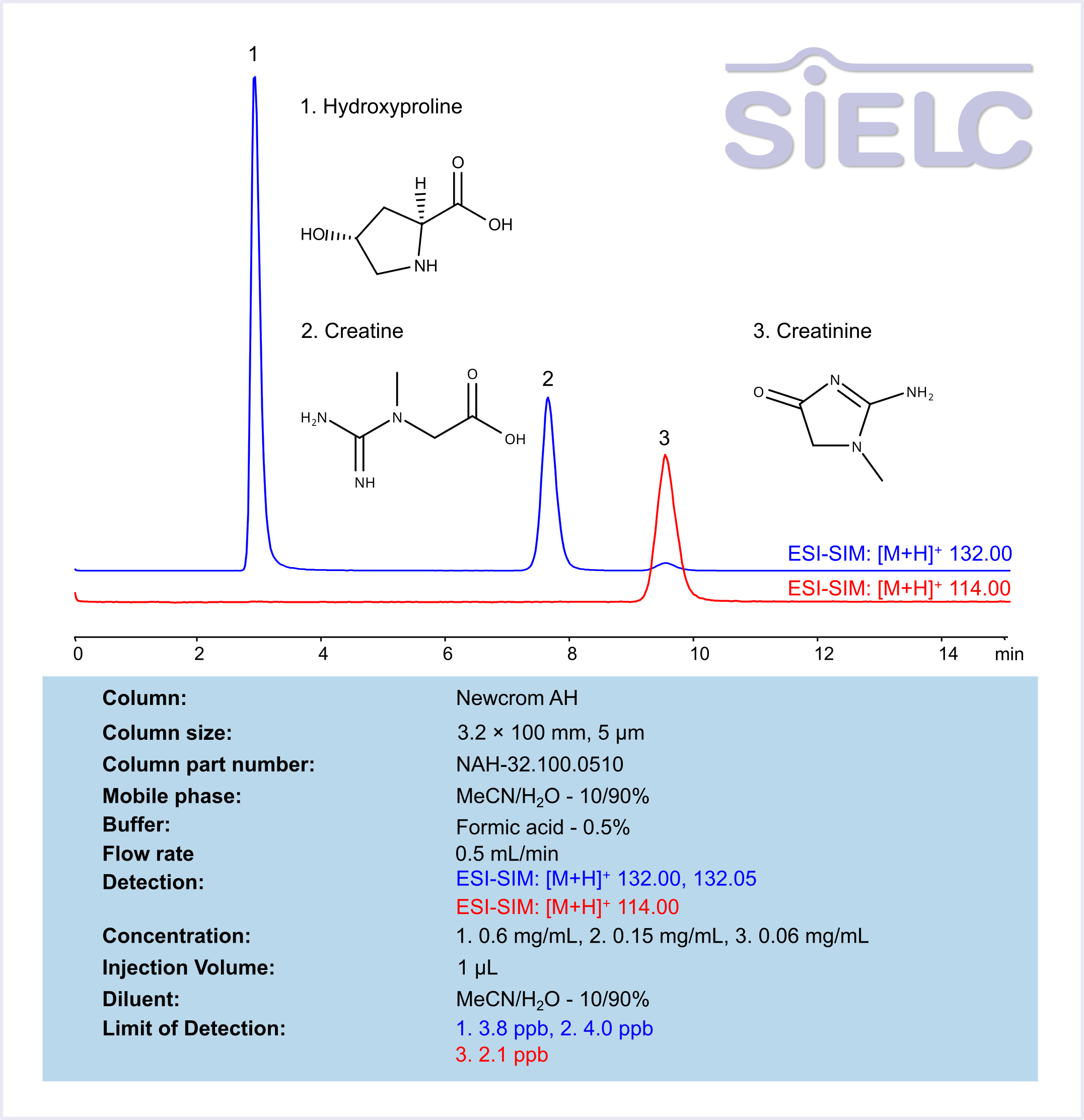
Hydroxyproline is a non-essential amino acid primarily found in collagen, the main structural protein in connective tissues such as skin, bones, and cartilage. It plays a crucial role in maintaining collagen stability and is often used as a biomarker for collagen turnover and connective tissue disorders. Creatine is a naturally occurring compound found in muscles and is used to produce energy during high-intensity exercise. It is synthesized in the body from amino acids and stored in muscles for quick energy release. Creatinine, on the other hand, is a waste product produced from the breakdown of creatine. It is filtered by the kidneys and excreted in urine. The measurement of creatinine levels in the blood and urine is commonly used to assess kidney function, as high levels may indicate impaired kidney function or other health issues.
Hydroxyproline, Creatine, and Creatinine can be analyzed and separated using a Newcrom AH mixed-mode stationary phase column. The analysis utilizes an isocratic method with a simple mobile phase consisting of water, acetonitrile (MeCN), and formic acid as a buffer. Mass spectrometric detection was carried out in ESI-SIM mode, monitoring the ions [M+H]+ at m/z 132.00, 132.05, 114.00.
Methodenparameter
| Column | Newcrom AH, 3.2 x 100 mm, 5 µm, 100 Å, dual ended |
|---|---|
| Mobile Phase | MeCN/H2O – 10/90% |
| Buffer | Formic Acid – 0.5% |
| Flow Rate | 0.5 mL/min |
| Detection | ESI-SIM: [M+H]+ 132.00, 132.05, 114.00 |
| Sample | 1. 0.6 mg/mL, 2. 0.15 mg/mL, 3. 0.06 mg/mL |
| Injection Volume | 1 µl |