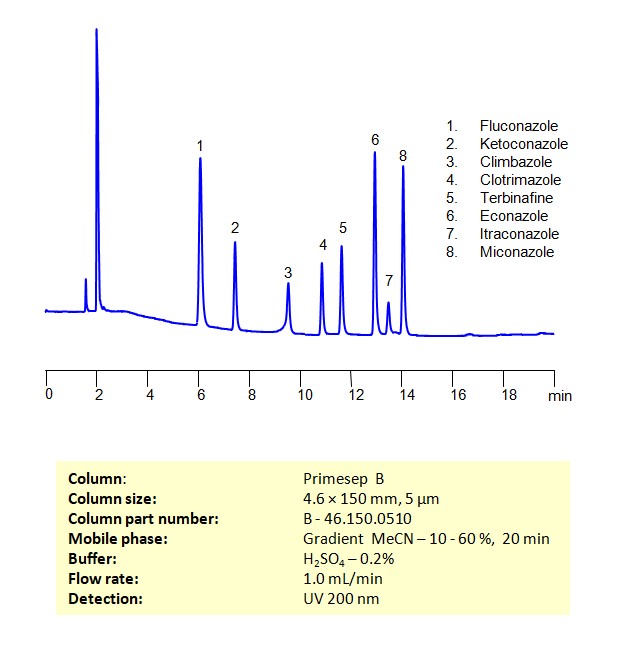
HPLC Method for Separation of a Mixture of Antifungal Agents on Primesep B Column
Antifungal agents are drugs used to treat fungal infections. Depending on their mechanism of action and chemical structure, antifungal agents can be categorized into several classes. Here are some of the main classes and examples of antifungal agents:
Of these, fluconazole, itraconazole, ketoconazole, climbazole, clotrimazole, econazole, and miconazole belong to the azole class, which primarily acts by inhibiting the fungal enzyme lanosterol 14α-demethylase. This enzyme is crucial for ergosterol synthesis, a vital component of fungal cell membranes. Terbinafine, on the other hand, inhibits squalene epoxidase, another enzyme important in ergosterol synthesis. Triclosan works through a different mechanism, targeting bacterial and fungal fatty acid synthesis.
Antifungal Agents can be separated, retained, and analyzed on a Primesep B mix mode phase column using an gradient analytical method with a simple mobile phase of water, Acetonitrile (MeCN), and sulfuric acid as a buffer. This analysis method can be detected in the UV 200 nm.
Methodenparameter
| Column | Primesep B, 4.6 x 150 mm, 5 µm, 100 Å, dual ended |
|---|---|
| Mobile Phase | Gradient MeCN – 10-60%, 20 min |
| Buffer | H2SO4 – 0.2% |
| Flow Rate | 1.0 mL/min |
| Detection | UV, 200 nm |