HPLC Method for Analysis of Ethyl Red
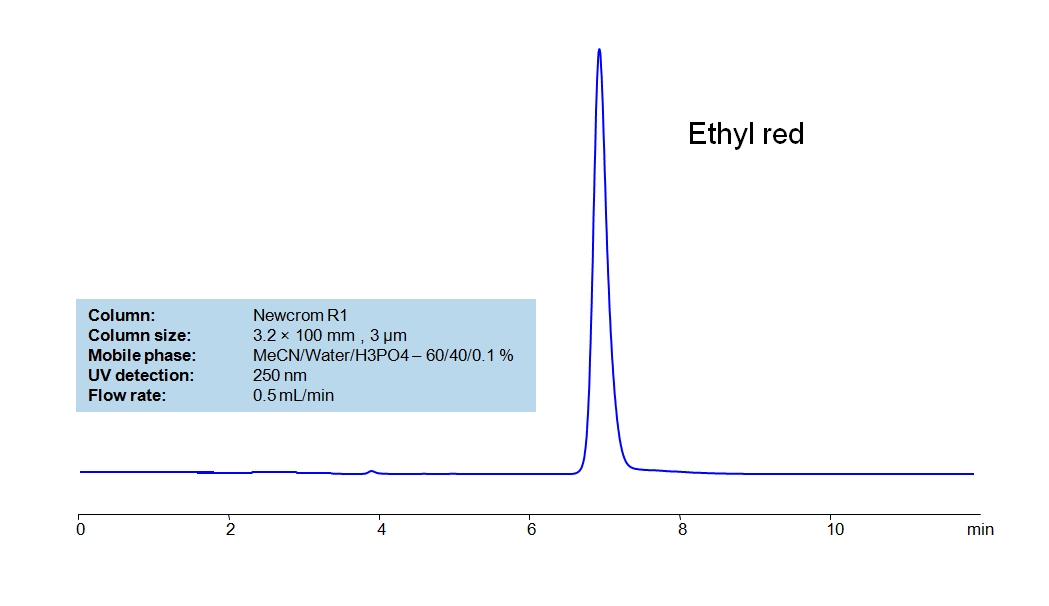
High Performance Liquid Chromatography (HPLC) Method for Analysis of Ethyl red
Ethyl red is a pH indicator with C17H19N3O2as its molecular structure. When the pH transitions from acidic to neutral, Ethyl red turns from yellow to red, hence the name. Outside of experiments, it is occasionally used as a dye in textiles and foods. You can find detailed UV spectra of Ethyl red and information about its various lambda maxima by visiting the following link.
Ethyl red can be retained and analyzed using the Newcrom R1 stationary phase column. The analysis utilizes an isocratic method with a simple mobile phase consisting of water and acetonitrile (MeCN) with a phosphoric acid buffer. Detection is performed using UV.
Methodenparameter
| Column | Newcrom R1, 3.2 x 100 mm, 5 µm, 100 Å, dual ended |
|---|---|
| Mobile Phase | MeCN/H2O – 60/10% |
| Buffer | H3PO4 – 0.1% |
| Flow Rate | 0.5 mL/min |
| Detection | UV, 250 nm |