HPLC Method for Analysis of Ethyl acetoacetate on Newcrom R1 Column
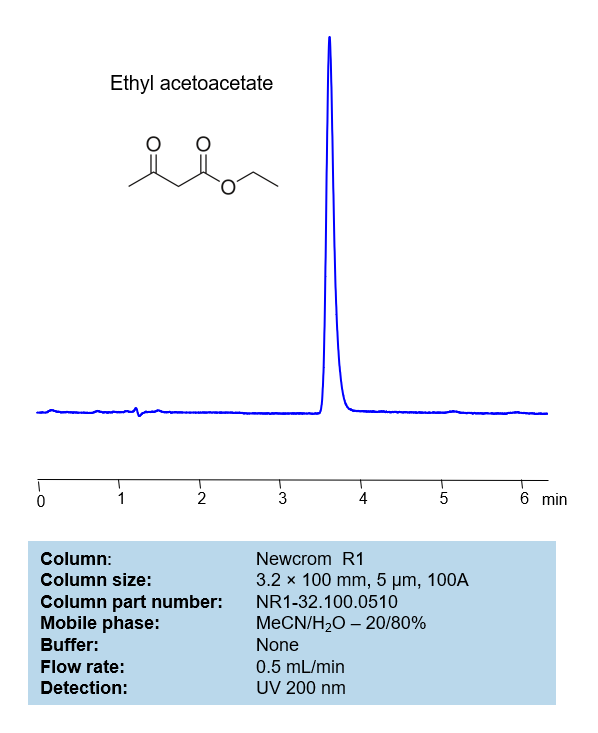
Separation type: Liquid Chromatography Mixed-mode
Ethyl acetoacetate (EAA) is an organic compound used in various applications, including as a starting material in organic synthesis and as a flavoring agent. It’s a type of chemical compound known as an ester, which means it contains a carbonyl group adjacent to an ether group.
In terms of structure, EAA contains two main parts: an ethyl group (a carbon and two hydrogens, CH3CH2-) and an acetoacetate group (CH3C(=O)CH2C(=O)O-).
In organic chemistry, EAA is known for its role in the Claisen condensation and other reactions where it behaves as an active methylene compound. An active methylene compound is a compound that contains a methylene group (CH2) adjacent to one or more electron-withdrawing groups, such as a carbonyl group, which can make the hydrogen atoms on the methylene group acidic and easily removed.
As a flavoring agent, it’s used in foods and beverages to impart apple and pear flavors.
Ethyl acetoacetate can be retained and analyzed on a reverse-phase Newcrom R1, 3.2 x 100 mm, 5 µm, 100 Å, dual ended column with a mobile phase consisting of water and Acetonitrile (MeCN). This analysis method can be detected with an Evaporative Light Scattering Detector (ELSD) or any other evaporative detection method (CAD, ESI-MS).
Methodenparameter
| Column | Newcrom R1, 3.2 x 100 mm, 5 µm, 100 Å, dual ended |
|---|---|
| Mobile Phase | MeCN/H2O -20/80% |
| Buffer | None |
| Flow Rate | 0.5 mL/min |
| Detection | UV 200 nm |
| Limit of Detection | 6 ppb |
| Injection Volume | 1 µl |