HPLC Method for Analysis of 3,3′-Diaminobenzidine (DAB) on BIST B+ Column
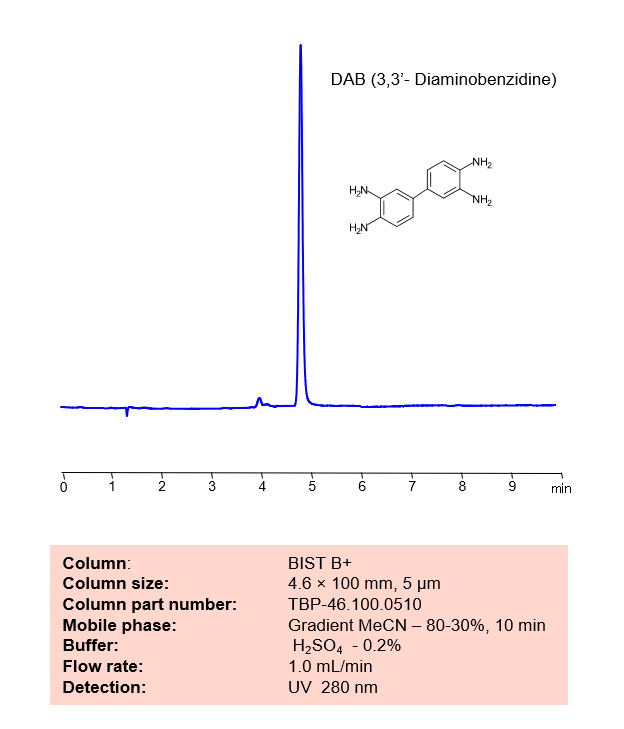
Separation type: Bridge Ion Separation Technology, or BIST™ by SIELC Technologies
3,3′-Diaminobenzidine (DAB) is an organic compound that is often used as a staining reagent in various scientific applications. Here’s some basic information about DAB:
Chemical Structure : DAB is a derivative of benzidine, and its chemical structure consists of two benzene rings linked by a two-nitrogen “bridge”. Each benzene ring also has an amino group (-NH2) attached, hence the name “diamino”.
Uses : DAB is primarily used as a substrate for the enzyme horseradish peroxidase (HRP) in techniques such as immunohistochemistry (IHC) and immunoblotting. In the presence of HRP and hydrogen peroxide, DAB undergoes a reaction that results in the formation of a brown precipitate. This can be used to visualize the location of specific proteins or other molecules in biological samples.
Safety Concerns : It’s important to note that DAB is potentially carcinogenic, and should be handled with appropriate safety measures, including wearing gloves and protective eyewear, and using the chemical in a fume hood whenever possible.
Solubility : DAB is slightly soluble in water, but can be dissolved in organic solvents such as ethanol, or in weakly acidic solutions. For use in staining procedures, it is often dissolved in a buffer solution, sometimes with the addition of a small amount of detergent to improve solubility.
Methodenparameter
| Column | BIST B+, 4.6 x 100 mm, 5 µm, 100 Å, dual ended |
|---|---|
| Mobile Phase | Gradient MeCN -80-30%, 10 min |
| Buffer | H2SO4 – 0.2% |
| Flow Rate | 1.0 mL/min |
| Detection | UV 280 nm |