HPLC Method for Analysis of Sucrose Octasulfate in Sucrose Octasulfate-aluminum Complex on BIST A+ Column
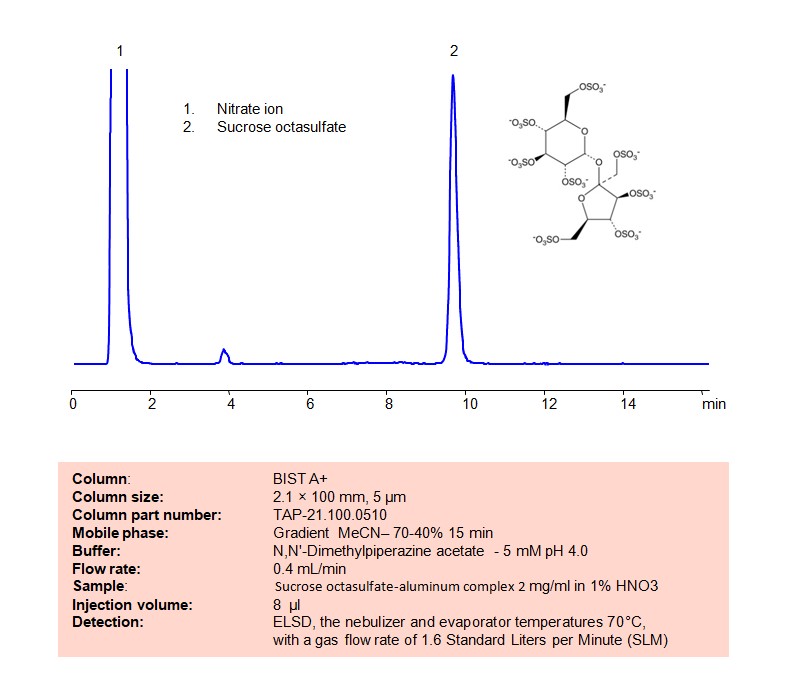
Separation type: Bridge Ion Separation Technology, or BIST™ by SIELC Technologies
he Sucrose octasulfate-aluminum complex is a chemical compound where sucrose octasulfate, a derivative of sucrose with eight sulfate groups, forms a complex with aluminum ions. This complex exhibits unique properties due to the interaction between the sulfated sugar and aluminum.
Structure and Composition: In this complex, aluminum ions interact with the sulfate groups of sucrose octasulfate. The exact structure depends on the ratio of sucrose octasulfate to aluminum and the conditions under which the complex is formed.
Properties: The combination of a large, organic, sulfated molecule with a metal ion like aluminum can result in changes in solubility, stability, and reactivity compared to the individual components. The properties of such complexes can be quite different from those of either sucrose octasulfate or aluminum alone.
Biological Interactions: The presence of both organic (sucrose octasulfate) and inorganic (aluminum) components can influence how this compound interacts with biological systems. For example, it might have specific binding properties or biological activity that are leveraged in therapeutic contexts.
Environmental and Health Considerations: As with any compound containing metal ions, there are considerations regarding environmental impact and human health, especially regarding the bioavailability and toxicity of aluminum.
Methodenparameter
| Column | BIST A+, 2.1 x 100 mm, 5 µm, 100 Å, dual ended |
|---|---|
| Mobile Phase | Gradienr MeCN – 70-40%, 15 min |
| Buffer | DMP acetate pH 4.0 – 5 mM |
| Flow Rate | 0.4 mL/min |
| Detection | ELSD, the nebulizer and evaporator temperatures 70°C, with a gas flow rate of 1.6 Standard Liters per Minute (SLM |
| Sample | 2 mg/ml in 1% HNO3 |
| Injection Volume | 8 µl |