HPLC Method for Analysis of Sucrose hexasulfate on BIST A+ Column
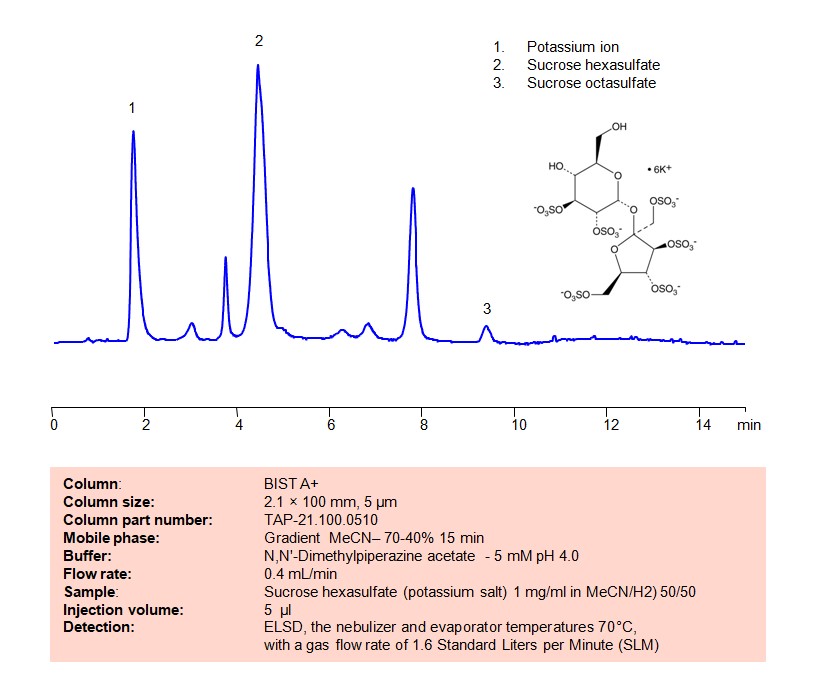
Separation type: Bridge Ion Separation Technology, or BIST™ by SIELC Technologies
Sucrose hexasulfate is a chemically modified form of sucrose, where six of the hydroxyl groups in the sucrose molecule are replaced with sulfate groups. This modification significantly alters the properties of the original sugar molecule.
Sucrose hexasulfate is a modified form of sucrose with unique chemical and physical properties due to the presence of sulfate groups, and its applications are more specialized compared to regular sucrose.
Using SIELC’s newly introduced BIST™ method, sucrose hexasulfate can be retained on a negatively-charged, cation-exchange BIST™ A column. There are two keys to this retention method: 1) a multi-charged, positive buffer, such as DMP acetate, which acts as a bridge, linking the negatively charged dye to the negatively-charged column surface and 2) a mobile phase consisting mostly of organic solvent (such as MeCN) to minimize the formation of a solvation layer around the charged analytes. Using this new and unique analysis method, oligonucleotide can be separated, retained, and detected at ELSD
Please read more on oligonucleotides analysis by HPLC in our April’s 2023 newsletter .
Methodenparameter
| Column | BIST A+, 2.1 x 100 mm, 5 µm, 100 Å, dual ended |
|---|---|
| Mobile Phase | Gradienr MeCN – 70-40%, 15 min |
| Buffer | DMP acetate pH 4.0 – 5 mM |
| Flow Rate | 0.4 mL/min |
| Detection | ELSD, the nebulizer and evaporator temperatures 70°C, with a gas flow rate of 1.6 Standard Liters per Minute (SLM |
| Sample | 1 mg/ml in MeCN/H2O – 50/50% |
| Injection Volume | 5 µl |