LCMS Method for Analysis of Glucosamine-1-Phosphate and Glucosamine-6-Phosphate on Primesep S Column
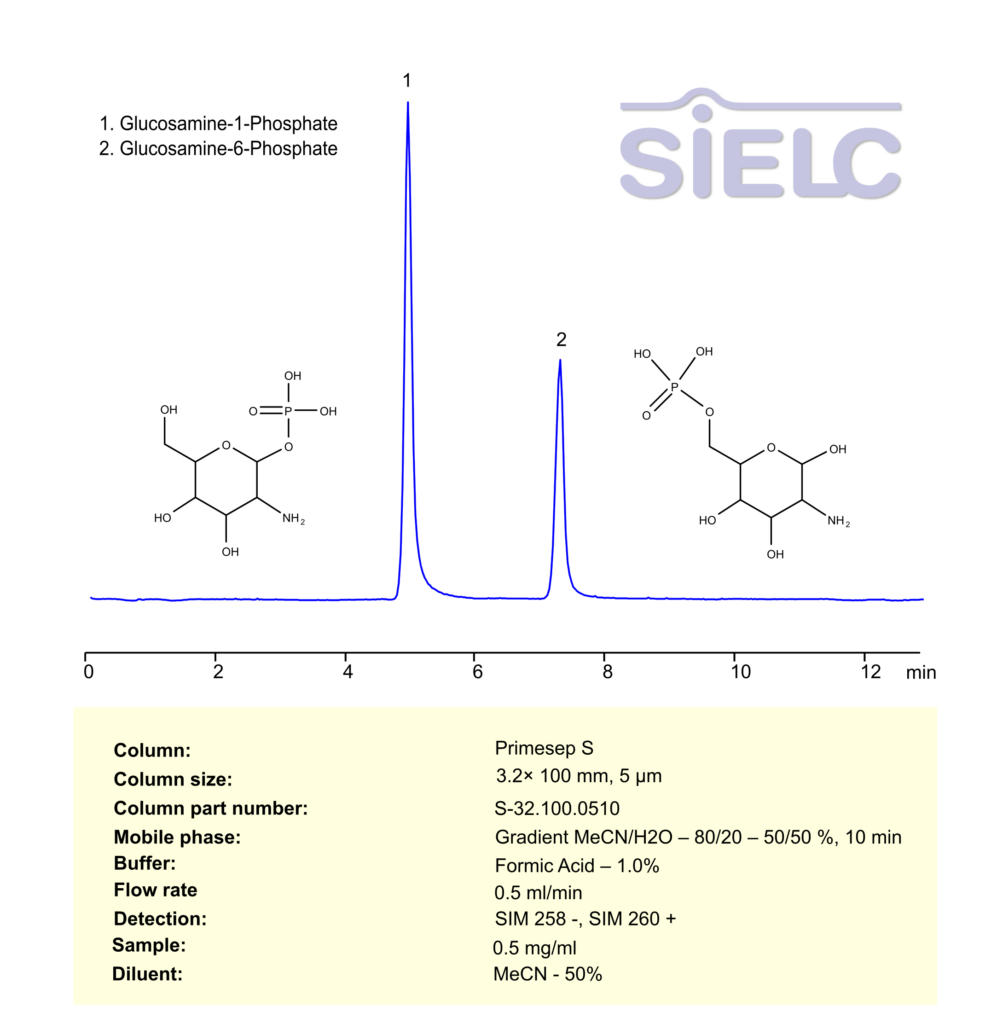
Glucosamine-1-phosphate and Glucosamine-6-phosphate are two different phosphorylation forms of glucosamine, a naturally occurring amino sugar that is part of the structure of certain glycosaminoglycans like chondroitin sulfate and hyaluronic acid.
Glucosamine-1-Phosphate:
It is the phosphorylated form of glucosamine at the first carbon atom. It is often involved in metabolic pathways that lead to the synthesis of UDP-glucose, which is a precursor in the synthesis of glycogen and glycosaminoglycans. It can also be an intermediate in the synthesis of amino sugars. Glucosamine-6-Phosphate:
This form is phosphorylated at the sixth carbon atom. It is an important intermediate in the hexosamine biosynthetic pathway, which is involved in the formation of UDP-N-acetylglucosamine (UDP-GlcNAc), a key substrate for the biosynthesis of glycosaminoglycans and glycoproteins. It plays a role in cellular signaling and regulation, especially in the context of insulin resistance and other metabolic processes. Both forms are critical in various biochemical pathways, particularly in the synthesis of complex carbohydrates and in maintaining cellular functions, including joint and connective tissue health.
Glucosamine-1-phosphate and Glucosamine-6-phosphate can be retained, separated and analyzed using an Primesep S mixed-mode stationary phase column. The analysis employs a gradient method with a simple mobile phase consisting of water, acetonitrile (MeCN), and formic acid as a buffer. Detection is achieved using LC MS.
Methodenparameter
| Column | Primesep S, 3.2 x 100 mm, 5 µm, 100 Å, dual ended |
|---|---|
| Mobile Phase | Gradient MeCN/H2O – 80/20 – 50/50%, 10 min |
| Buffer | Formic Acid – 1.0% |
| Flow Rate | 0.5 mL/min |
| Detection | SIM258 -, SIM260 + |
| Sample | 0.5 mg/ml |
| Injection Volume | 1 µl |