HPLC Separation of Uracil, Thymine, Guanine, Cytosine, Adenine on Newcrom AH
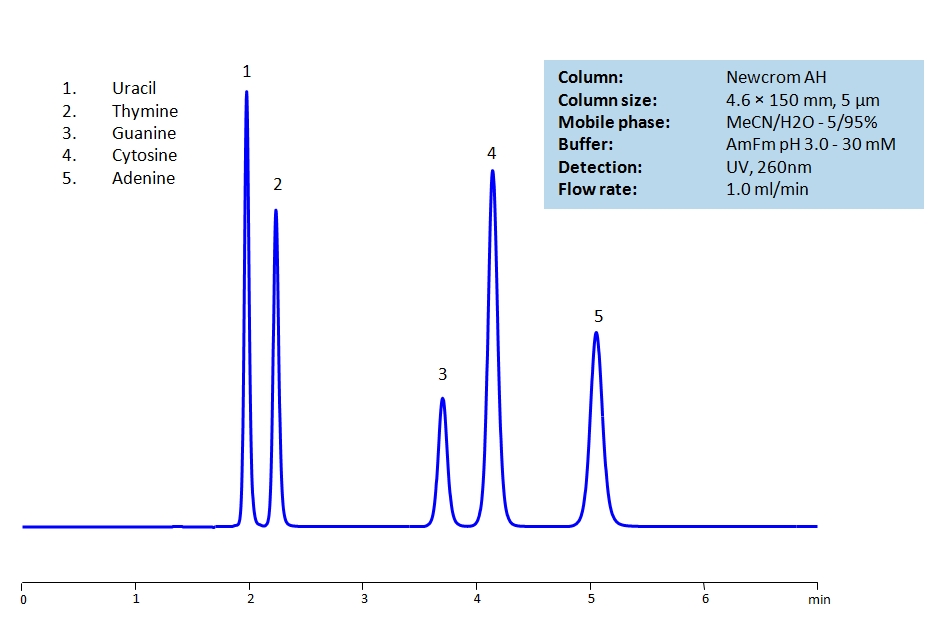
High Performance Liquid Chromatography (HPLC) Method for Analysis of Uracil , Thymine , Adenine , Cytosine , Guanine .
Uracil , Thymine , Guanine , Cytosine and Adenine are the nucleobases found in RNA and DNA.
Uracil , also noted as U and Ura , has C4H4N2O2chemical formula. It is a derivative of pyrimidine that is rarely found in DNA, working more often in RNA in transcription by binding to adenine through hydrogen bonds. You can find detailed UV spectra of Uracil and information about its various lambda maxima by visiting the following link .
Thymine , also noted as T and Thy , has the chemical formula C5H6N2O2 . It is a a pyrimidine nucleobase that may be produced through methylation of uracil. In DNA, it creates a double hydrogen bond to Adenine to hold together the structure of DNA.
Guanine , also noted as G and Gua , has the chemical formula C5H5N5O . By forming three hydrogen bonds with the Cytosine, it creates a base pair. It’s name comes from the Spanish term “guano”, meaning bird or bat dropping, as that is said to have been how it was first discovered. Outside of DNA, Guanine that is harvested from fish scales, is occasionally used in cosmetics for it’s luster.
Cytosine , also noted as C and Cyt , has the chemical formula C4H5N3O . In DNA, it pairs with Guanine to create a base pair. In RNA, it is synonymous with Uracil, being an interchangeable third base. Not only that, due to it’s instability, it can change into Uracil through spontaneous deamination.
Methodenparameter
| Column | Newcrom AH, 4.6 x 150 mm, 5 µm, 100 Å, dual ended |
|---|---|
| Mobile Phase | H2O – 100% |
| Buffer | AmFm pH 3.0- 10 mM |
| Flow Rate | 1.0 mL/min |
| Detection | UV 260 nm, MS-compatible mobile phase |