HPLC Separation of Lactic Acid and Its Oligomers
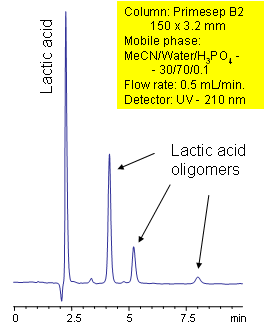
Lactic acid (milk acid) is natural organic acid that plays an important role in biochemical processes. It has carboxylic and hydroxy-groups which upon standing can react with each other and form dimers, trimers and higher oligomers. Lactic acid is a polar molecule that produces no retention on reversed-phase column. Primesep B2 mixed-mode anion-exchange column is used for the separation of lactic acid and its oligomers by a combination of weak reversed-phase and anion-exchange mechanisms. Oligomers of lactic acid can be converted to lactic acid by hydrolysis. Primesep B2 column can be used for the analysis of lactic acid alone and lactic acid in the mixture of oligomers. Lactates can be monitored by low UV, ELSD or LC/MS. In case of ELSD, CAD or LC/MS, phosphoric acid in the mobile phase needs to be replaced with buffer compatible with these detection techniques (ammonium formate or TFA).
Methodenparameter
| Column | Primesep B2, 3.2×150 mm, 5 µm, 100 Å |
|---|---|
| Mobile Phase | MeCN/H2O – 30/70% |
| Buffer | H3PO4 – 0.1% |
| Flow Rate | 0.5 mL/min |
| Detection | UV 210 nm |