HPLC Separation of Chloranil and Tetrachlorohydroquinone on Newcrom B Column
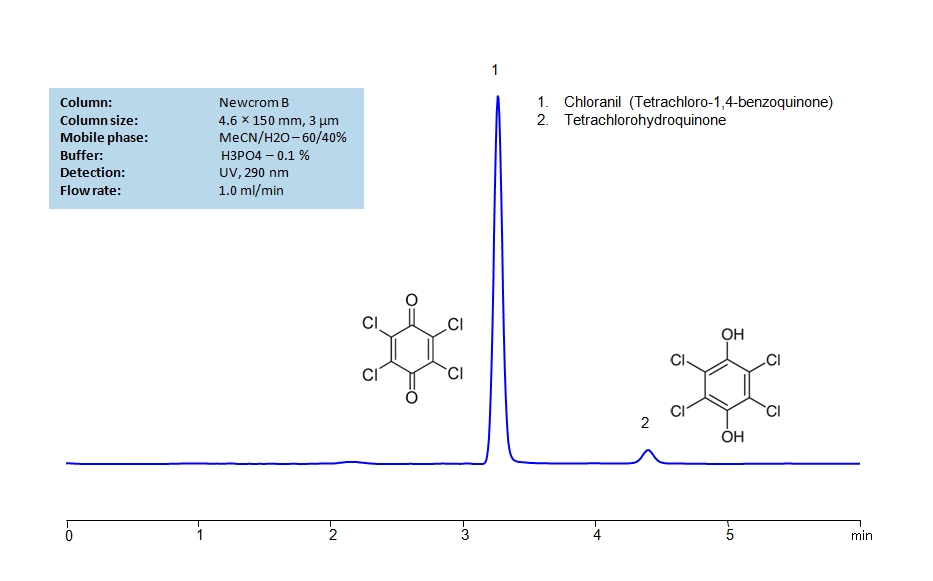
High Performance Liquid Chromatography (HPLC) Method for Analysis of Chloranil , Tetrachlorohydroquinone .
Chloranil , also known as tetrachloro-1,4-benzoquinone, is a quinone with the chemical formula C6Cl4O2 . It is a planar molecule that functions as an oxidant. It serves as a hydrogen acceptor and is more electrophilic than quinone. Chloranil is used to test for free secondary amines, which is useful to check for the presence of proline derivatives. Commercially, it is a precursor to dyes.
Tetrachlorohydroquinone , also known as TCHQ , is a chlorinated organic compound with the chemical formula C6H2Cl4O2 . It is a metabolote of the biocide pentachlorophenol. It causes damage to cells by increasing reactive oxygen species (ROS). It is harmful if swallowed and can cause serious eye damage.
Chloranil , Tetrachlorohydroquinone can be retained and analyzed using the Newcrom B stationary phase column. The analysis utilizes an isocratic method with a simple mobile phase consisting of water and acetonitrile (MeCN) with a phosphoric acid buffer. Detection is performed using UV.
Methodenparameter
| Column | Newcrom B, 4.6 x 150 mm, 3 µm, 100 Å, dual ended |
|---|---|
| Mobile Phase | MeCN/H2O – 60/40% |
| Buffer | H3PO4 – 0.1% |
| Flow Rate | 1.0 mL/min |
| Detection | UV 290 nm |