HPLC MS Method for Analysis of Kinetin Phytohormone on Primesep 200 Column
Separation type: Liquid Chromatography Mixed-mode SIELC Technologies
Kinetin is a type of cytokinin, a class of phytohormones that play a crucial role in promoting cell division, growth, and delaying aging (senescence) in plants. It was one of the first cytokinins discovered and is often used in plant tissue culture and agriculture to enhance plant growth and development. Kinetin is a powerful cytokinin that is critical for cell division, shoot formation, and delaying aging in plants. Its application spans plant tissue culture, agriculture, and even the cosmetic industry.
Kinetin was first isolated from degraded DNA in herring sperm in 1955, though it is not commonly found in high concentrations in plants compared to other cytokinins like zeatin. However, kinetin is naturally occurring and has been detected in various plant tissues.
Kinetin binds to cytokinin receptors in plants, initiating a signaling cascade that leads to gene expression changes, promoting cell division and growth. Its action is often in opposition to auxins, and both hormones work together to balance root and shoot growth.
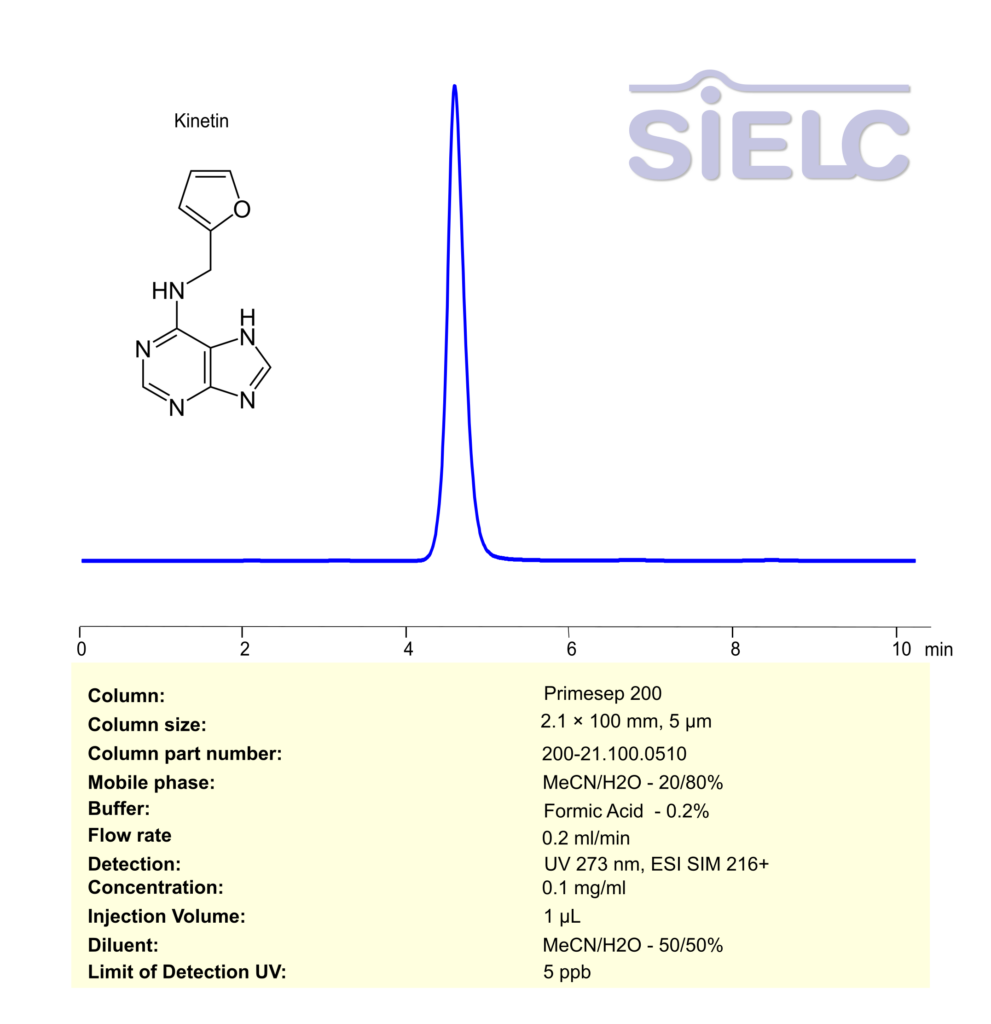
Kinetin can be retained, separated and analyzed using a Primesep 200 mixed-mode stationary phase column. The analysis employs an isocratic method with a simple mobile phase comprising water, acetonitrile (MeCN), and formic acid as a buffer. This method allows for detection using UV 273 nm.
You can find detailed UV spectra of Kinetin and information about its various lambda maxima by visiting the following link .
Methodenparameter
| Column | Primesep 200, 2.1 x 100 mm, 5 µm, 100 Å, dual ended |
|---|---|
| Mobile Phase | MeCN – 20% |
| Buffer | Formic Acid -0.2% |
| Flow Rate | 0.2 mL/min |
| Detection | UV 273 nm, MSESISIM216+ |