HPLC Method for Separation of Folic Acid and Aminopterin on Primesep 100 Column
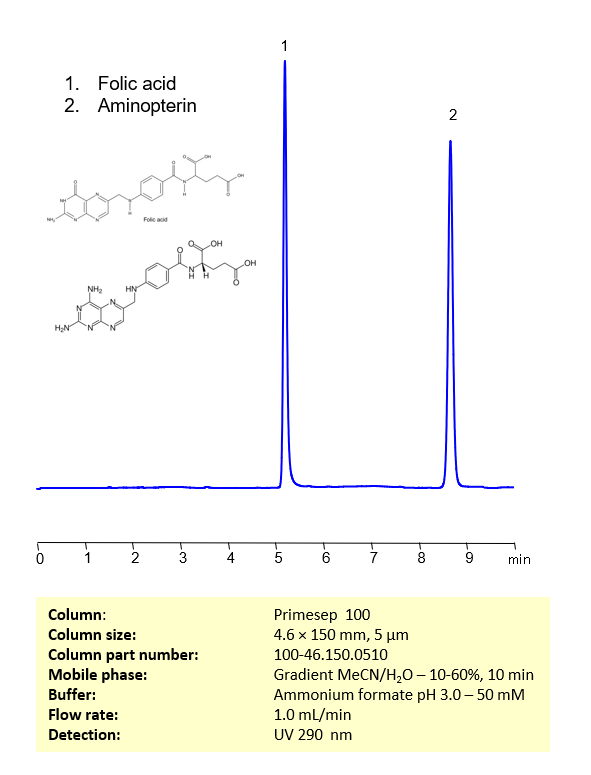
Separation type: Liquid Chromatography Mixed-mode
Aminopterin and folic acid are chemically related compounds that play significant roles in biochemistry and medicine.
Folic acid, also known as vitamin B9, is an essential nutrient that our bodies need to function correctly. It plays a vital role in many bodily functions, including DNA synthesis and repair, cell division and growth, and the production of red blood cells. Humans cannot synthesize folic acid and, therefore, must obtain it through their diet or via supplementation.
Aminopterin is a derivative of folic acid. It was one of the first antifolate drugs, a class of medication that inhibits the enzyme dihydrofolate reductase (DHFR). This enzyme is critical for converting folic acid into its active form, tetrahydrofolate, which is used in the synthesis of nucleotides for DNA and RNA.
By inhibiting DHFR, aminopterin interferes with the synthesis of DNA and RNA, blocking cell replication. This property made it useful as a cancer drug, as it can stop the rapid cell division characteristic of cancerous cells. However, aminopterin is highly toxic and is no longer used clinically. It has been largely replaced by less toxic and more effective antifolate drugs, such as methotrexate.
It’s important to note that while aminopterin and folic acid are chemically related, their biological effects are very different due to their interactions with the enzyme DHFR. Always consult with a healthcare provider for accurate and up-to-date information.
Methodenparameter
| Column | Primesep 100, 4.6 x 150 mm, 5 µm, 100 Å, dual ended |
|---|---|
| Mobile Phase | Gradient MeCN -10-60%, 10 min |
| Buffer | Ammonium formate pH 3.0 – 50 mM |
| Flow Rate | 1.0 mL/min |
| Detection | UV 290 nm |
| Limit of Detection | 0.04 ppm |
| Injection Volume | 5 µl |