HPLC Method for Analysis of Mellitic Acid on Newcrom BH Column
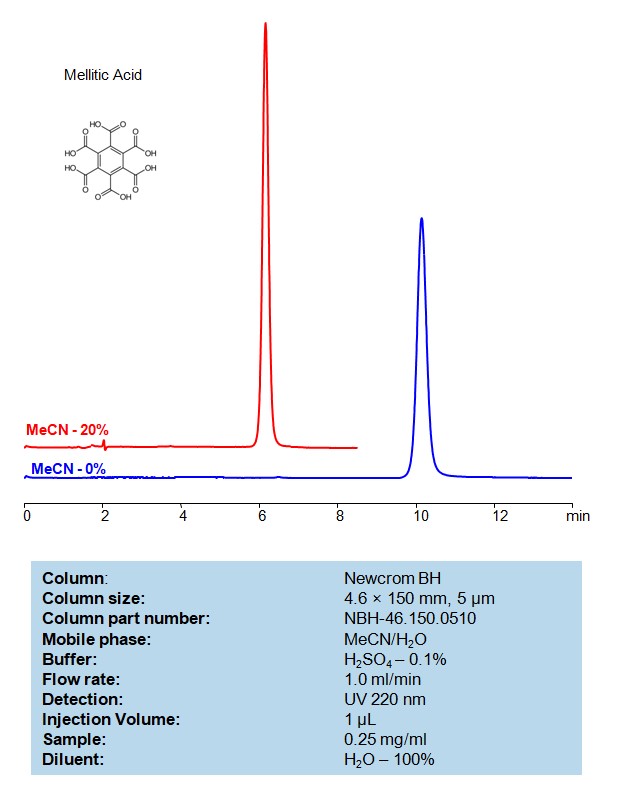
Separation type: Liquid Chromatography Reversed-phase
Mellitic Acid is an aromatic dicarboxylic acid with the chemical formula C12H6O12. It is a white crystalline solid and is derived from benzoic acid. Mellitic acid is named after mellite, a mineral in which it was first discovered. It is not commonly encountered in everyday use and does not have widespread applications.
Chemical Structure: Mellitic acid consists of a benzene ring with six carboxylic acid functional groups (-COOH) attached to it, forming a hexacarboxylic acid.
Occurrence: Mellitic acid is not a naturally abundant compound and is primarily known for its existence as a mineral, mellite, which contains mellitic acid.
Uses: Due to its structure and properties, mellitic acid does not have significant practical applications in industry or daily life. It is more commonly encountered in scientific contexts and research.
Derivatives: Mellitic acid can form various derivatives, and some of its salts and esters have been studied for specific purposes.
Methodenparameter
| Column | Newcrom BH, 4.6 x 150 mm, 5 µm, 100 Å, dual ended |
|---|---|
| Mobile Phase | MeCN/H2O |
| Buffer | H2SO4 – 0.1% |
| Flow Rate | 1.0 mL/min |
| Detection | UV 220 nm |
| Sample | 0.25 mg/ml |
| Injection Volume | 1 µL |