HPLC Method for Analysis of Lactobionic Acid on Newcrom BH Column
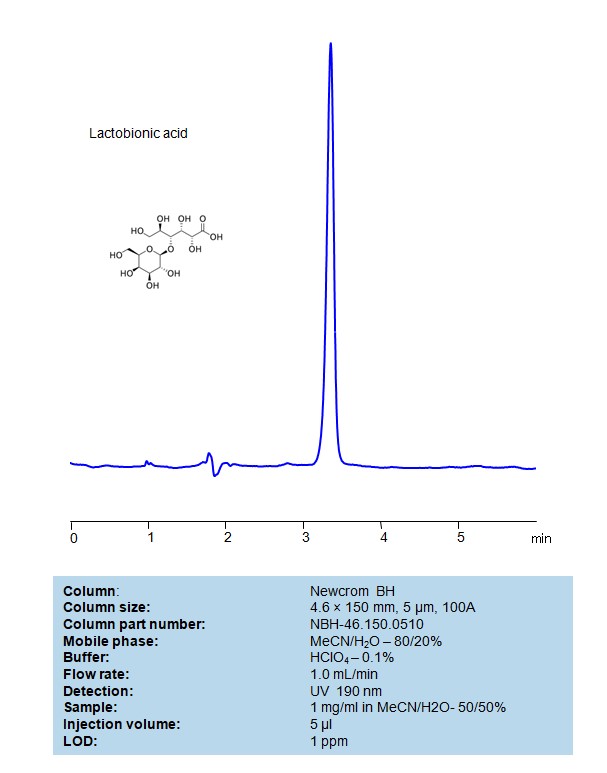
Separation type: Liquid Chromatography Reversed-phase
Lactobionic Acid is a compound derived from lactose, a sugar found in milk. It is a bionic acid, which is a type of sugar acid that contains both a sugar and a carboxylic acid group. Lactobionic acid has applications in various industries, including pharmaceuticals, cosmetics, and food production, due to its properties such as antioxidant activity and its ability to chelate metal ions. In pharmaceuticals, it is used as an excipient in formulations, while in cosmetics, it is found in skincare products for its hydrating and exfoliating properties. Additionally, it is used as a food additive, particularly in processed foods, as a stabilizer and antioxidant.
Lactobionic Acid can be retained and analyzed on a reversed-phase Newcrom BH column with a mobile phase consisting of water, Acetonitrile (MeCN), and perchloric acid. This analytical method can be detected with high resolution and peak symmetry at a wavelength of 190 nm using UV detection
*LOD was determined for this combination of instrument, method, and analyte, and it can vary from one laboratory to another even when the same general type of analysis is being performed.
Methodenparameter
| Column | Newcrom BH, 4.6 x 150 mm, 5 µm, 100 Å, dual ended |
|---|---|
| Mobile Phase | MeCN/H2O – 80/20% |
| Buffer | HClO4 – 0.1% |
| Flow Rate | 1.0 mL/min |
| Detection | UV 190 nm |
| Sample | 1 mg/ml |
| Injection Volume | 3 µL |