HPLC Method for Analysis of Galactose on Primesep S2 Column
Galactose is a monosaccharide sugar that plays a crucial role in the biochemistry of living organisms. It is one of the components of lactose, the sugar found in milk, and is thus commonly ingested in a diet that includes dairy products. Here’s more detailed information about galactose:
Galactose is vital in various biological processes and also presents a unique set of challenges due to its role in metabolic disorders like galactosemia. Understanding its biochemistry and metabolic pathways has implications in healthcare, dietetics, and even biotechnological applications.
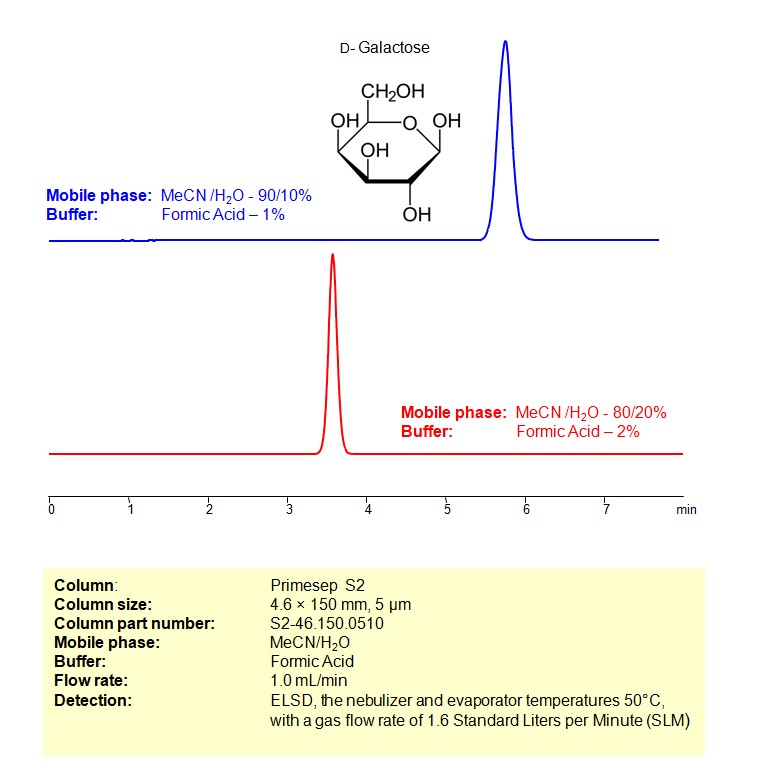
Galactose can be retained, and analyzed on a Primesep S2 mixed-mode stationary phase column using an isocratic analytical method with a simple mobile phase of water, Acetonitrile (MeCN), and a formic acid as a buffer. This analytical method can be detected with high resolution and peak symmetry with many evaporative detection methods, including Evaporative Light Scattering Detection (ELSD), Charged Aerosol Detector (CAD), and Electrospray Ionization (ESI) for Mass Spectrometry (MS).
Methodenparameter
| Column | Primesep S2, 4.6 x 150 mm, 5 µm, 100 Å, dual ended |
|---|---|
| Mobile Phase | MeCN/H2O |
| Buffer | Formic Acid |
| Flow Rate | 1.0 mL/min |
| Detection | ELSD, the nebulizer and evaporator temperatures 50°C, with a gas flow rate of 1.6 Standard Liters per Minute (SLM) |