HPLC Method for Analysis of Bupivacaine on Primesep 200 Column
Separation type: Liquid Chromatography Mixed-mode
Bupivacaine is a local anesthetic drug. It belongs to the amide group of local anesthetics and is used to block nerve impulses, thereby reducing pain and discomfort in a specific area of the body.
Bupivacaine can be administered through injection or via a topical solution, depending on the procedure. It is often used for surgical, dental, and obstetric procedures, and can also be used for the treatment of chronic pain.
The onset of action of bupivacaine is relatively rapid (1-4 minutes depending on use), and its effects can last for several hours, making it useful for procedures that require a long duration of anesthesia.
Bupivacaine can have significant side effects and risks, particularly if it enters the bloodstream, and it should always be administered by a qualified healthcare provider. These side effects can include cardiovascular issues, central nervous system effects, and allergic reactions.
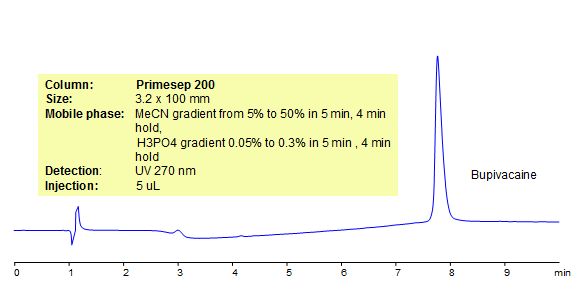
Bupivacaine can be analyzed on a reverse-phase Primesep 200, 3.2 x 100 mm, 5 µm, 100 Å, dual ended column with a mobile phase consisting of water, Acetonitrile (MeCN) and Phosphoric acid as a buffer modifier. This analysis method can be UV detected at 270 nm.
Methodenparameter
| Column | Primesep 200, 3.2 x 100 mm, 5 µm, 100 Å, dual ended |
|---|---|
| Mobile Phase | Gradient MeCN – 5-50% |
| Buffer | Gradient H3PO4 – 0.05-0.3%, 5 min, 4 min hold |
| Flow Rate | 0.5 mL/min |
| Detection | UV, 270 nm |