Separation of Model Compounds in Reversed-Phase and Mixed-Mode
https://sielc.com/separation-of-model-compounds-in-reversed-phase-and-mixed-modeChromatogram
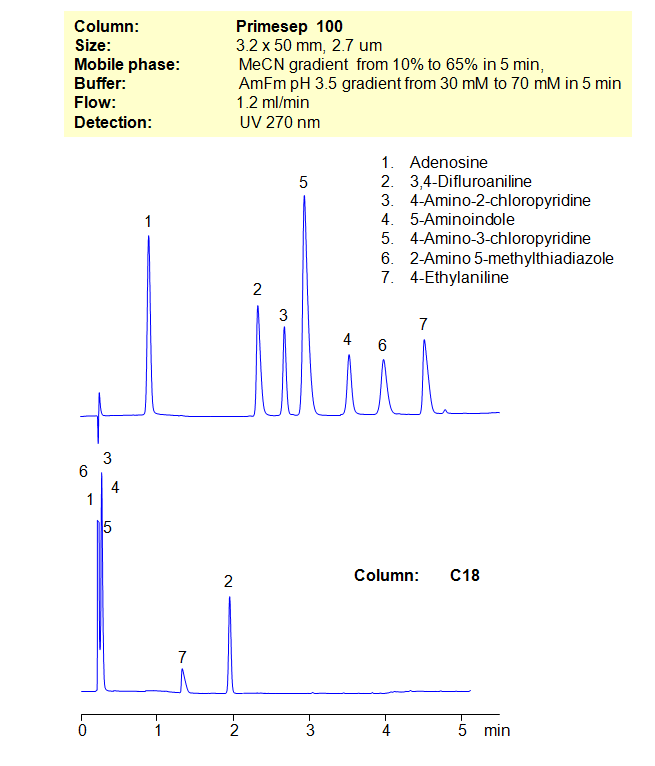
Description
· Separation type: Liquid Chromatography Mixed-mode
High Performance Liquid Chromatography (HPLC) Method for Analysis of Adenosine , 3,4-Difluoroaniline , 4-Amino-2-Chloropyridine , 4-Amino-3-Chloropyridine , 2-Amino-5-Methylthiadiazole , 2-Amino-5-methyl-thiazole , 4-Ethylaniline , 5-Aminoindole .
Many compounds are difficult, if not impossible, to separate on reverse-phase columns in HPLC. Other compounds cannot be separated on ion-exchange columns. That’s where the mixed-mode columns come in. By using a stationary phase with both hydrophobic and ion-exchange properties, allows the chromatographer to have additional controls over separation conditions. Here, we demonstrate the separation of compounds that can’t be achieved on a C18 column. By using both an organic gradient and buffer gradient of ammonium formate (AmFm), we can separate structurally similar compounds that can’t be separated on a reverse-phase column alone.
Method Parameters
| Mobile Phase | Gradient MeCN – 10-60%, 5 min |
|---|---|
| Buffer | Gradient AmFm pH 3.5- 30 – 70 mM, 5 min |
| Flow Rate | 1.2 ml/min |
| Detection | UV, 270 nm |
| Class of Compounds | Drug, Basic, Hydrophilic, Hydrophobic, Ionizable. |
| Analyzing Compounds | Adenosine,3,4-Difluoroaniline,4-Amino-2-Chloropyridine,4-Amino-3-Chloropyridine,2-Amino-5-Methylthiadiazole,2-Amino-5-methyl-thiazole,4-Ethylaniline,5-Aminoindole |