HPLC Method for Separation of Hydrophobic, Cationic, Nonionic and Anionic Surfactants on Newcrom BH Column
https://sielc.com/hplc-separation-surfactantsChromatogram
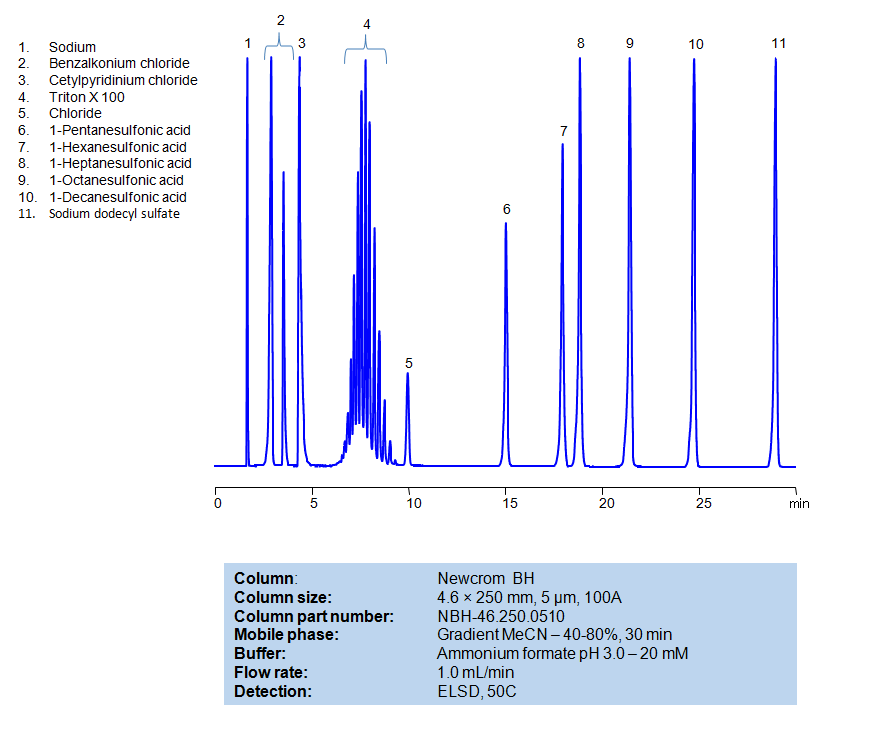
Description
· Separation type: Liquid Chromatography Mixed-mode · HPLC Method for Separation of Hydrophobic, Cationic, Nonionic and Anionic Surfactants
Surfactants, also known as surface-active agents, are compounds that lower the surface tension (or interfacial tension) between two liquids or between a liquid and a solid. Surfactants may act as detergents, wetting agents, emulsifiers, foaming agents, or dispersants.
They are often classified according to the charge of the polar head group:
Anionic Surfactants: These surfactants have a negative charge on their polar head group. Common examples include soap, sodium laureth sulfate, and sodium lauryl sulfate. They are commonly used in detergents and shampoos due to their ability to emulsify oils and hold dirt in suspension, so it can be rinsed away.
Cationic Surfactants: These surfactants have a positive charge on their polar head group. Examples include cetyltrimethylammonium bromide (CTAB) and benzalkonium chloride. These are often used as antiseptics and can also be found in hair conditioners because they reduce static cling.
Nonionic Surfactants: These surfactants have no charge on their polar head group. Examples include alcohol ethoxylates, nonylphenol ethoxylates, and polysorbates. Nonionic surfactants are often used in laundry and dishwasher detergents.
Method Parameters
| Mobile Phase | Gradient MeCN -40-80%, 30 min |
|---|---|
| Buffer | Ammonium formate pH 3.0 – 20 mM |
| Flow Rate | 1.0 ml/min |
| Detection | ELSD, 50C |
| Class of Compounds | Aliphatic sulfonic acid |
| Analyzing Compounds | Benzalkonium chloride,Cetylpyridinium Chloride,Triton X100,1-Pentanesulfonic acid,1-Hexanesulfonic acid, sodium salt,1-Heptanesulfonic acid,1-Decanesulfonic acid,Sodium dodecyl sulfate,1-Octanesulfonic acid |