HPLC Method for Analysis of Rhamnopterin on Primesep 100 Column
https://sielc.com/hplc-separation-of-rhamnopterinChromatogram
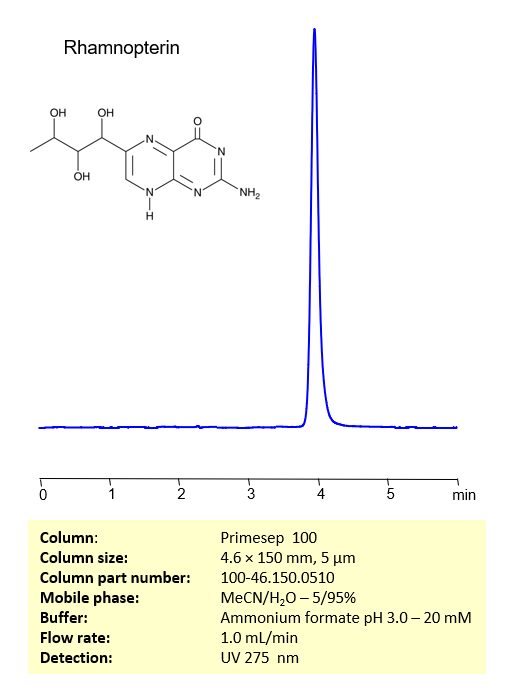
Description
· High Performance Liquid Chromatography (HPLC) Method for Analysis of Rhamnopterin .
Rhamnopterin is a derivative of L-biopterin, D-biopterin, and the oxidized form of tetrahydro-L-biopterin (BH4) with the formula C 10 H 13 N 5 O 4 . It has exhibited significant properties in dietary studies. When administered in a 0.5% concentration alongside the carcinogen 4-dimethylaminoazobenzene, it can reduce the incidence of liver tumors induced by this carcinogen in rats. In addition to these therapeutic applications, rhamnopterin has also been utilized as an internal standard for quantifying biopterin and neopterin levels in rat plasma, as demonstrated in LC-MS-based studies. You can find detailed UV spectra of Rhamnopterin and information about its various lambda maxima by visiting the following link.
Rhamnopterin retained and analyzed using a reverse-phase Primesep 100 column. The mobile phase for this method consists of water, acetonitrile (MeCN), and ammonium formate, which serves as a buffer. This analytical method can be monitored using UV detection at 275 nm, an Evaporative Light Scattering Detector (ELSD), or any other evaporative detection method such as Charged Aerosol Detection (CAD) or Electrospray Ionization Mass Spectrometry (ESI-MS)
LOD was determined for this combination of instrument, method, and analyte, and it can vary from one laboratory to another even when the same general type of analysis is being performed.
Method Parameters
| Mobile Phase | MeCN/H2O -5/95% |
|---|---|
| Buffer | Ammonium formate pH 3.0 – 20 mM |
| Flow Rate | 1.0 ml/min |
| Detection | UV 275 nm |
| Peak Retention Time | 3.28 min |
| Sample concentration | 0.02 mg/ml |
| Injection volume | 5 µl |
| Sample diluent | H2O + NaOH |
| LOD | 20 ppb |
| Class of Compounds | Pteridines |
| Analyzing Compounds | Rhamnopterin |