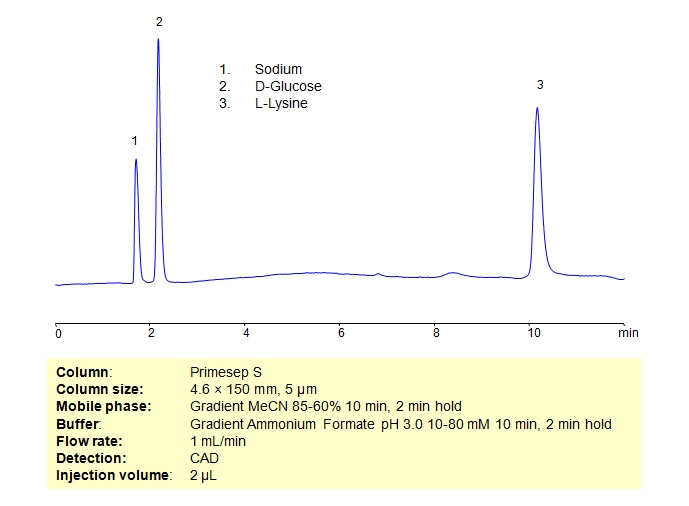
HPLC Separation of Mixture of D-Glucose and L-Lysine on Primesep S Column
https://sielc.com/hplc-separation-of-mixture-of-d-glucose-and-l-lysineChromatogram
Description
· High Performance Liquid Chromatography (HPLC) Method for Analysis of Glucose , Lysine .
Sodium , which has a chemical symbol of Na , is a soft alkali metal that is highly reactive. It is found in abundance in everyday materials like table salt, sea water, and even the Earth’s crust. It is crucial for the body’s function and fluid balance.
D-Glucose is a simple sugar that is generated during photosynthesis. In humans, it is produced during hepatic gluconeogenesis. In many living organisms, it acts as an essential energy source. It is the most commonly occurring isomer of glucose in nature. It’s chemical formula is C₆H₁₂O₆ .
L-Lysine is an essential amino acid with the chemical formula C 6 H 14 N 2 O 2 . As an amino acid, lysine is a building block for proteins. It’s crucial for health, but the body can’t produce it, so it must come from the diet. Lysine has been used in supplements to improve athletic performance, support immune health, and more. It’s also integral in the production of carnitine, a nutrient responsible for converting fatty acids into energy and helping to lower cholesterol.
Glucose , Lysine can be retained and analyzed using the Primesep S stationary phase column. The analysis utilizes a gradient method with a simple mobile phase consisting of water and acetonitrile (MeCN) with an ammonium formate buffer. Detection is performed using CAD.
Method Parameters
| Mobile Phase | Gradient MeCN – 85-60%, 10 min 2 min hold |
|---|---|
| Buffer | Gradient AmFm pH 3.0, 10-80 mM, 10 min 2 min hold |
| Flow Rate | 1.0 ml/min |
| Detection | CAD (Corona) MS- compatible mobile phase |
| Class of Compounds | Sugar, Amino Acid, Hydrophilic, Ionizable, Vitamin, Supplements |
| Analyzing Compounds | Glucose,Lysine |