HPLC Method for Analysis of Glutathione oxidized (GSSG) on Primesep 100 Column
https://sielc.com/hplc-separation-of-gssg-2Chromatogram
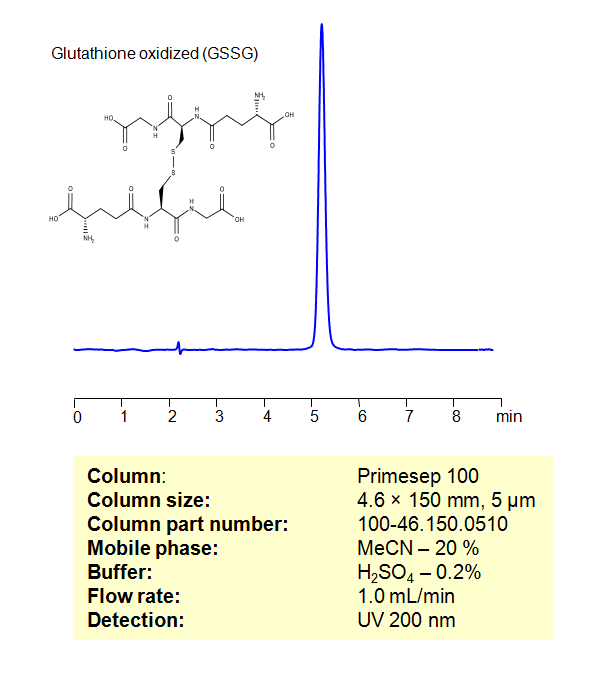
Description
· High Performance Liquid Chromatography (HPLC) Method for Analysis of Glutathione oxidized (GSSG) .
Oxidized glutathione , or glutathione disulfide ( GSSG ), is a form of the antioxidant molecule glutathione with the chemical formula C 20 H 32 N 6 O 12 S 2 . Glutathione exists in two forms: the reduced form (GSH), which is the active antioxidant, and the oxidized form (GSSG). When glutathione neutralizes a free radical or a reactive oxygen species, it becomes oxidized and forms GSSG. The ratio of GSH to GSSG within cells is often used as a measure of cellular oxidative stress.
The body can convert GSSG back into the active GSH form using an enzyme called glutathione reductase, provided there are adequate levels of NADPH, a compound integral to many cellular processes, including the antioxidant response.
Glutathione disulfide (GSSG) retained and analyzed using a reverse-phase Primesep 100, 4.6 x 150 mm, 5 µm, 100 A, dual ended column. The mobile phase for this method consists of water, acetonitrile (MeCN), and sulfuric acid, which serves as a buffer. This analytical method can be monitored using UV detection at 200 nm.
LOD was determined for this combination of instrument, method, and analyte, and it can vary from one laboratory to another even when the same general type of analysis is being performed.
Method Parameters
| Mobile Phase | MeCN/H2O -20/80% |
|---|---|
| Buffer | H2SO4 – 0.2% |
| Flow Rate | 1.0 ml/min |
| Detection | UV 200 nm |
| Peak Retention Time | 5,12 min |
| Sample concentration | 0.5 mg/ml |
| Injection volume | 1 µl |
| Sample diluent | H2O + NaOH |
| LOD | 50 ppb |
| Class of Compounds | Thiol, Amino acid |
| Analyzing Compounds | Glutathione oxidized (GSSG) |