HPLC Method for Separation of Amines on BIST B and BIST B+ Columns
https://sielc.com/hplc-separation-of-amines-bistChromatogram
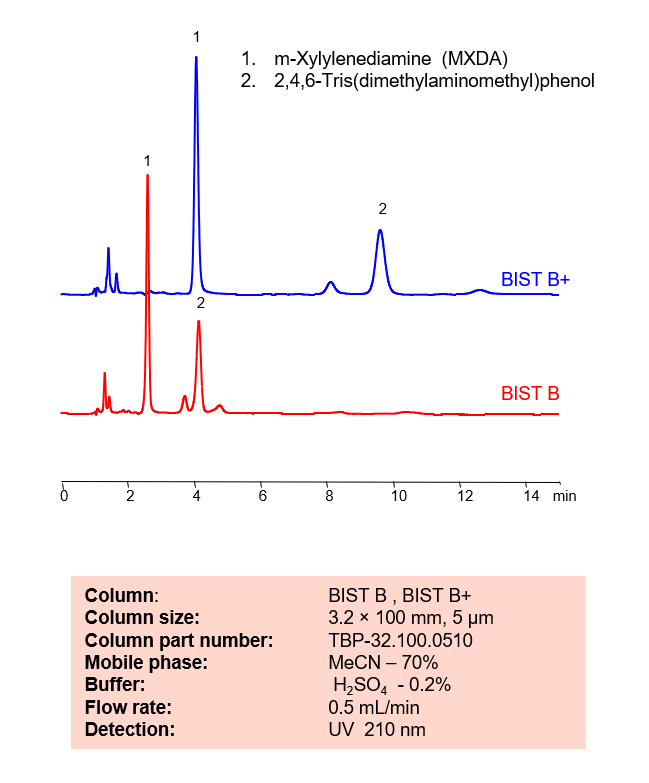
Description
· Separation type: Bridge Ion Separation Technology, or BIST™ by SIELC Technologies
m-Xylylenediamine (MXDA) is a popular curing agent used on epoxy resins. 2,4,6-Tris(dimethylaminomethyl)phenol is another amine-based curing agent used on epoxy resins. Using SIELC’s newly introduced BIST™ method, these amines can be retained and separated on a positively charged, anion-exchange BIST™ B or BIST™ B+ column. The surface chemistry of BIST™ B+ columns are designed to have stronger ionic retention capabilities, resulting in the marked increase in retention compared to BIST™ B columns.
There are two keys to this retention method: 1) a multi-charged, negative buffer, such as Sulfuric acid (H2SO4), which acts as a bridge, linking the positively charged dipeptide to the positively charged column surface and 2) a mobile phase consisting mostly of organic solvent (such as MeCN) to minimize the formation of a solvation layer around the charged analytes. Using this new and unique analysis method, these two amines can be UV detected at 210 nm.
Method Parameters
| Mobile Phase | MeCN – 70% |
|---|---|
| Buffer | H2SO4 – 0.2% |
| Flow Rate | 0.5 ml/min |
| Detection | UV 210 nm |
| Class of Compounds | Amines |
| Analyzing Compounds | m-Xylylenediamine,2,4,6-Tris(dimethylaminomethyl)phenol |