HPLC Separation of Adenosine mono-, di- and triphosphates on Newcrom BH Column
https://sielc.com/hplc-separation-of-adenosine-mono-di-and-triphosphates-on-newcrom-bh-columnChromatogram
Description
High Performance Liquid Chromatography (HPLC) Method for Analysis of Adenosine Monophosphate , Adenosine Diphosphate , Adenosine Triphosphate
Adenosine Triphosphate (ATP) is a nucleotide with the chemical formula C 10 H 16 N 5 O 13 P 3. It is a primary energy carrier of the cell and is crucial to cellular energy metabolism. ATP is generated in the mitochondria and is used in numerous various cellular processes. It releases energy when a phosphate linkage breaks from it, creating adenosine diphosphate.
Adenosine Diphosphate (ADP) , also known as adenosine pyrophosphate, is a compound with the formula C 10 H 15 N 5 O 10 P 2 . It is a precursor in the synthesis of DNA and RNA. Medications that block ADP receptors on platelets prevent blood clots in conditions like heart attacks and strokes.
Adenosine Monophosphate (AMP) is a nucleotide with the chemical formula C 10 H 14 N 5 O 7 P . Due to being a byproduct of ATP and ADP, it can be reused by the body for energy at higher forms. AMP can be converted into cyclic adenosine monophosphate (cAMP) to become a second messenger in the body, relaying signals between cells.
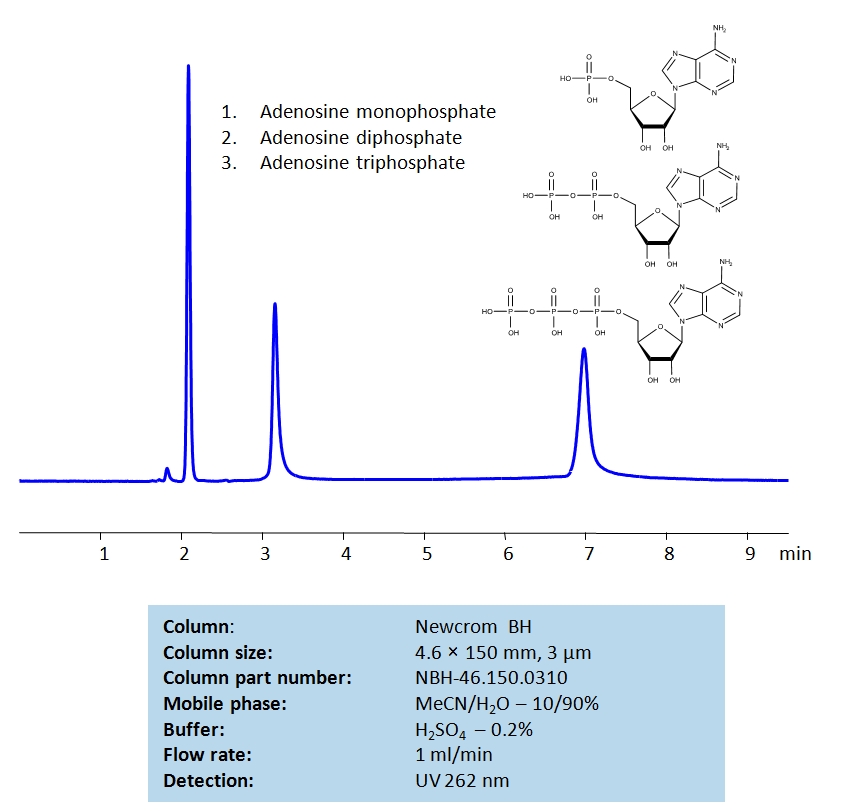
Using a Newcrom BH mixed-mode column and a mobile phase consisting of water and acetonitrile with a sulfuric acid (H2SO4) buffer, adenosine mono-, di- and triphosphate can be separated, measured, and analyzed. This method can UV detect this family of compounds at 262 nm with very high resolution.
Method Parameters
| Mobile Phase | MeCN/H2O – 10/90% |
|---|---|
| Buffer | H2SO4 – 0.2% |
| Flow Rate | 1.0 ml/min |
| Detection | UV 262nm |
| Class of Compounds | Acid, Hydrophilic |
| Analyzing Compounds | Adenosine Monophosphate,Adenosine Diphosphate,Adenosine Triphosphate |