HPLC MS Method for Analysis of Trichloroacetic acid (TCA) on BIST A+ Column
https://sielc.com/hplc-ms-determination-of-tcaChromatogram
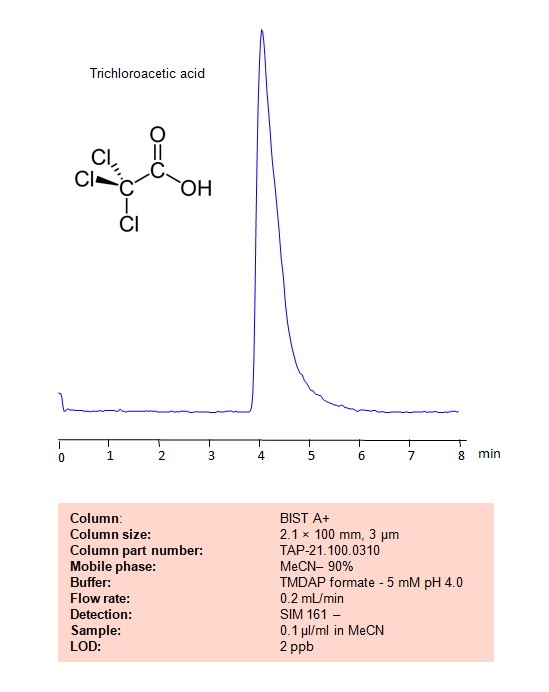
Description
· HPLC Method for Analysis of Trichloroacetic acid on BIST A+ Column by SIELC Technologies
Trichloroacetic Acid (TCA) , also known as trichloroethanoic acid , is an analogue of acetic acid with the chemical formula C 2 HCl 3 O 2 . It is a strong organic acid and a derivative of acetic acid, where three of the four hydrogen atoms in the methyl group of acetic acid are replaced by chlorine atoms. It is often used as a skin peeling treatment to exfoliate damaged skin and encourage collagen production. TCA also serves as a reagent in various chemical reactions, such as the production of pharmaceuticals, dyes, and pesticides. In laboratory research, it is used for precipitating proteins and to extract and prepare standards for ascorbic acid (Vitamin C) assays. TCA is employed to precipitate nucleic acids (DNA and RNA) from solution, facilitating their isolation and purification in molecular biology experiments. You can find detailed UV spectra of Trichloroacetic acid and information about its various lambda maxima by visiting the following link.
Trichloroacetic acid can be retained and analyzed on a BIST A+ column using an analytical method with a simple mobile phase of water, Acetonitrile (MeCN) , and a TMDAP formate as a buffer. This analysis method can be detected using LC MS.
Method Parameters
| Mobile Phase | MeCN/H2O – 90/10% |
|---|---|
| Buffer | TMDAP formate – 5 mM pH 4.0 |
| Flow Rate | 0.2 ml/min |
| Detection | SIM 161- |
| Sample | 0.1µl/ml |
| LOD* | 2 ppb |
| Class of Compounds | Bis-biguanide |
| Analyzing Compounds | Trichloroacetic acid |