HPLC Method for Analysis of Low MW Polylysine on BIST™ B+ Column
https://sielc.com/hplc-method-of-low-mw-polylysineChromatogram
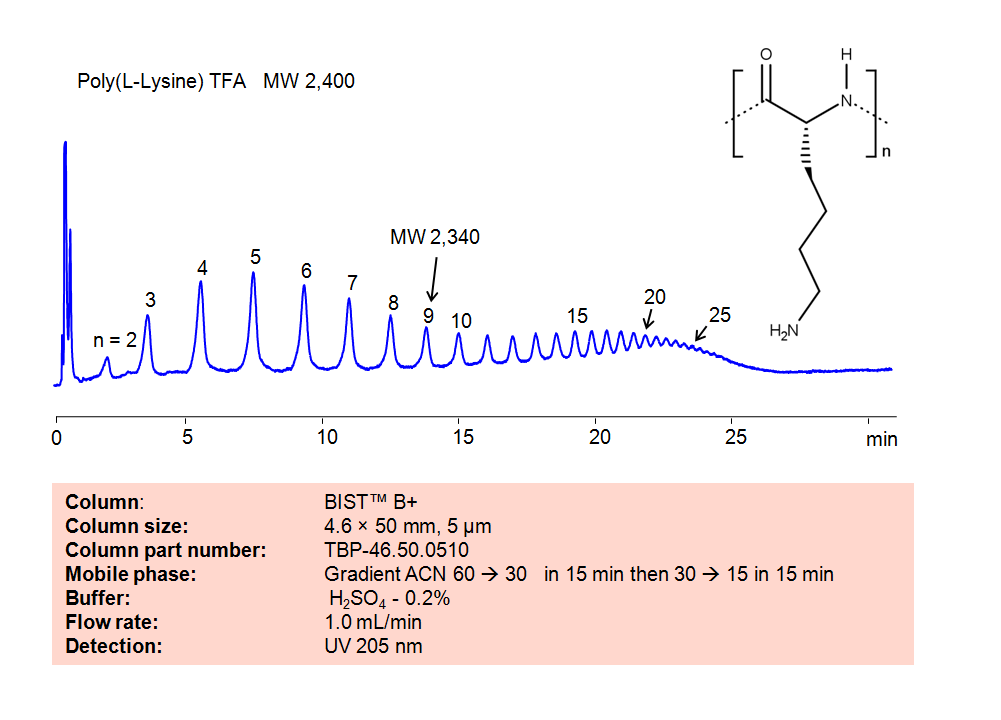
Description
· HPLC Method for Analysis of Polylysine on BIST B+ by SIELC Technologies .
Polylysine is a group of lysine homopolymers with the chemical formula (C 6 H 12 N 2 O) n . Due to its’ high positive charge density, it is often used in drug delivery for complexes with negatively charged macromolecules. They have been especially useful in delivery of DNA and proteins.
Polylysine includes a large group of similar polymers with various uses. Some are used as food preservatives, while others are used for drug delivery in pharmaceuticals. Polymers with charged monomeric units, such as polylysine, are often difficult to separate using typical ion-exchange chromatography due to very strong and often irreversible interactions with the oppositely charged column surface. Therefore, an extremely high concentration of the buffer, up to several molar, is usually needed to facilitate an ion-exchange process. This high buffer concentration, however, is not desirable because of the significantly increased viscosity of the mobile phase and the salt formation in the pump components. With BIST™, these polymers can be separated and retained with relatively weak buffers (in the mM regime) and a fairly simple gradient. Using this new and unique analysis method, Polylysine can be retained and UV detected at 205 nm.
Method Parameters
| Mobile Phase | Gradient MeCN |
|---|---|
| Buffer | H2SO4 – 0.2% |
| Flow Rate | 1.0 ml/min |
| Detection | UV 205 nm |
| Class of Compounds | Peptide, Homopolypeptide |
| Analyzing Compounds | Polylysine |