HPLC Method for Separation of Cytosine, Deoxycytidine and Cytidine on BIST B+ Column
https://sielc.com/hplc-method-of-cytosine-deoxycytidine-cytidineChromatogram
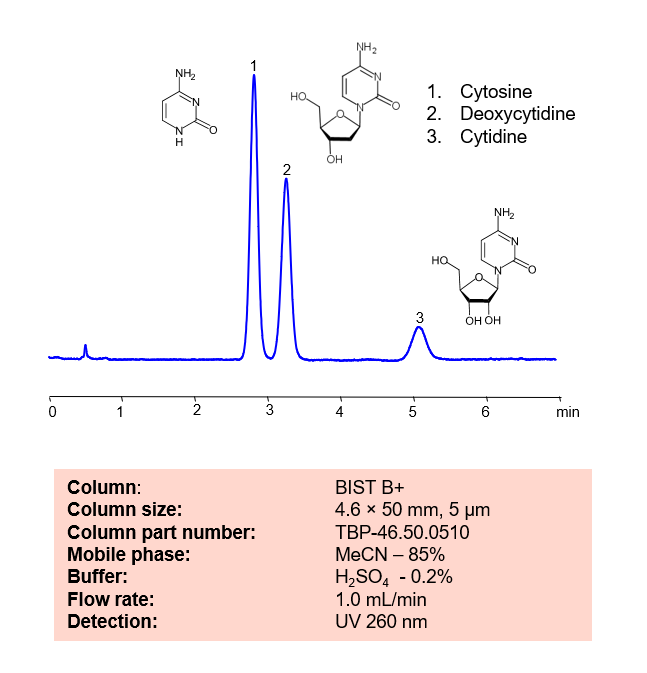
Description
· HPLC Method for Separation of Cytosine , Deoxycytidine , Cytidine on BIST B+ by SIELC Technologies .
Cytosine , also noted as C and Cyt , has the chemical formula C 4 H 5 N 3 O . In DNA, it pairs with Guanine to create a base pair. In RNA, it is synonymous with Uracil, being an interchangeable third base. Not only that, due to it’s instability, it can change into Uracil through spontaneous deamination.
Deoxycytidine is a deoxyribonucleoside with the chemical formula C 9 H 13 N 3 O 4 . It is a precursor for 5-aza-2′-cytidine, which is a treatment for myelodysplastic syndrome. It works through interfering with the methylation of the P15/INK4B gene. It can also be used as a biomarker for tumor diagnosis.
Cytidine , also noted as C or Cyd , is a nucleoside molecule with the chemical formula C 9 H 13 N 3 O 5 . It is primarily found in foods with high RNA contents, such as organ meets, brewer’s yeast, and beer. During digestion, Cyd is broken down into ribosyl pyrimidines.
Cytosine , Deoxycytidine , Cytidine can be retained and analyzed using the BIST B+ stationary phase column. The analysis utilizes an isocratic method with a simple mobile phase consisting of water and acetonitrile (MeCN) with a sulfuric acid buffer. Detection is performed using UV.
Method Parameters
| Mobile Phase | MeCN – 85% |
|---|---|
| Buffer | H2SO4 – 0.2% |
| Flow Rate | 1.0 ml/min |
| Detection | UV 260 nm |
| Peak Retention Time | 2.8, 3.2, 5.1 min |
| Class of Compounds | Nucleosides |
| Analyzing Compounds | Cytosine,Deoxycytidine,Cytidine |