HPLC Method for Simultaneous Determination of -Quat Herbicides on Obelisc R Column
https://sielc.com/hplc-method-for-simultaneous-determination-of-quat-herbicidesChromatogram
Description
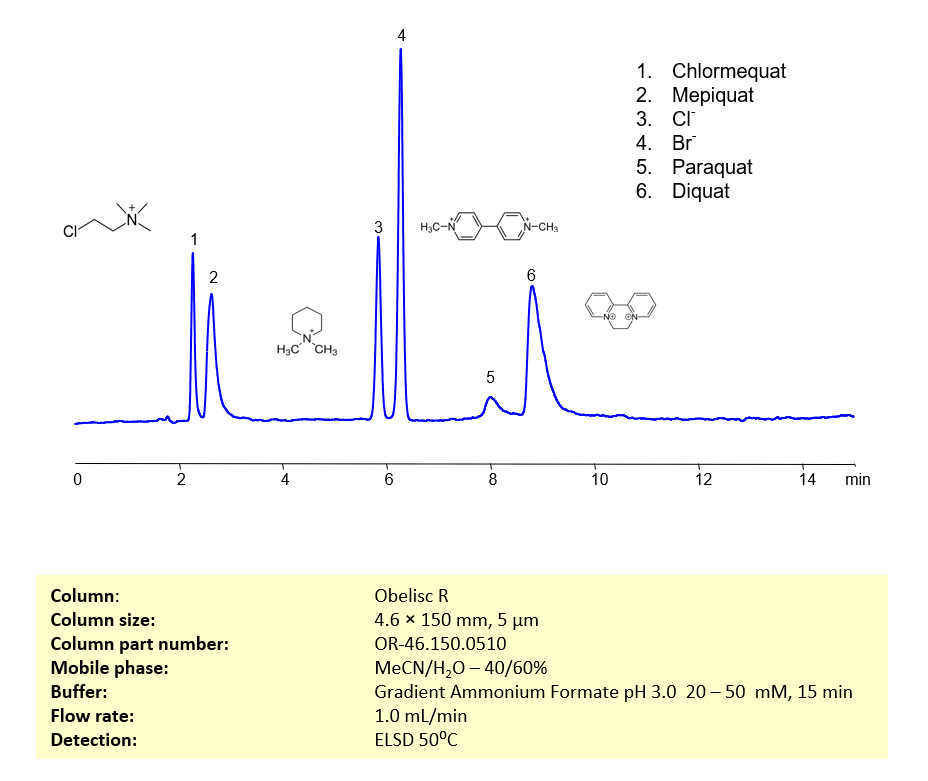
High Performance Liquid Chromatography (HPLC) Method for Analysis of Mepiquat , Paraquat , Diquat , Chlorocholine .
Chlormequat is a plant growth regulator with the chemical formula C 5 H 13 ClN . It works through inhibiting gibberellin biosynthesis, which leads to reduced cell elongation and thicker stalks.
Mepiquat is a plant growth regulator with the chemical formula C 7 H 16 N + . It is used primarily to control the growth rate and quality of the yield.
Paraquat is a widely used, non-selective herbicide known for its high efficacy in controlling a wide range of weeds. It has been an important tool in agriculture since its introduction in the mid-20th century. However, its use is accompanied by significant safety concerns due to its high toxicity.
Diquat is an organic dication that is used as a contact herbicide. It has the chemical formula C 12 H 12 Br 2 N 2 . It is considered moderately toxic and harmful if swallowed, inhaled, or absorbed through skin. It degrades slowly when in nature due to bonding strongly to minerals and organic particles. Due to that, it is no longer approved for use in the European Union.
Mepiquat , Paraquat , Diquat , Chlorocholine can be retained and analyzed using the Obelisc R stationary phase column. The analysis utilizes an isocratic method with a simple mobile phase consisting of water and acetonitrile (MeCN) with an ammonium formate buffer. Detection is performed using UV.
Method Parameters
| Mobile Phase | MeCN – 40% |
|---|---|
| Buffer | Ammonium Formate pH 3.0 |
| Flow Rate | 1.0 ml/min |
| Detection | ELSD 50C |
| Class of Compounds | Herbicides |
| Analyzing Compounds | Mepiquat,Paraquat,Diquat,Chlorocholine |