HPLC Method for Separation of Procainamide and Procaine on Newcrom A Column
https://sielc.com/hplc-method-for-analysis-procainamide-procaineChromatogram
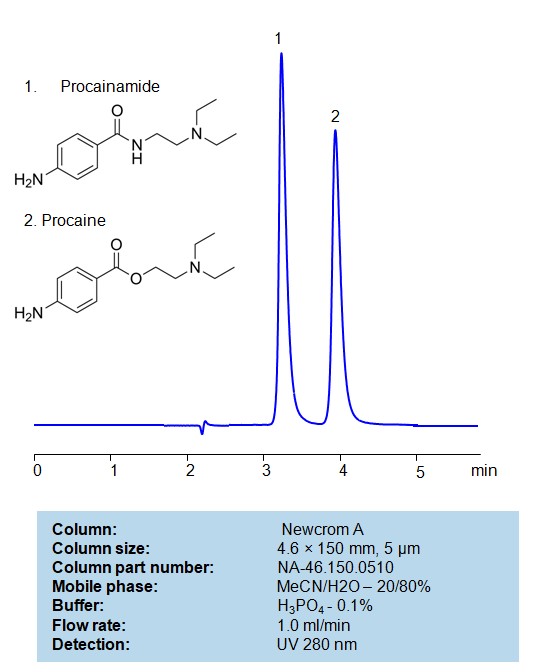
Description
Procainamide is an antiarrhythmic medication with the chemical formula C 13 H 21 N 3 O . It belongs to the Class Ia antiarrhythmic drugs. It is used to treat certain types of abnormal heart rhythms (arrhythmias) by stabilizing the cell membrane and reducing excitability in the heart muscle. Procainamide works by inhibiting sodium channels in cardiac cells, prolonging the action potential duration and refractory period, which helps in controlling irregular heartbeats. It is typically administered intravenously or orally under medical supervision.
Procaine is a local anesthetic drug with the chemical formula C 13 H 20 N 2 O 2 . It belongs to the amino ester group of local anesthetics. It is employed for local anesthesia, providing pain relief in various medical and dental settings. Procaine works by blocking nerve impulses and causing temporary loss of sensation in a specific area of the body. It is usually administered through injection to induce local anesthesia. You can find detailed UV spectra of Procainamide , Procaine and information about its various lambda maxima by visiting the following link.
Procainamide is primarily used for cardiac conditions, while procaine is utilized as a local anesthetic for pain management during medical and dental procedures. While both compounds have a shared ancestry in PABA and contain amine groups, the specific functional groups (amide vs. ester) and their positions in the molecules contribute to their distinct pharmacological properties. It’s a good observation that small structural changes can lead to significant differences in the pharmacological actions of compounds.
Procainamide , Procaine can be retained, separated and analyzed using a Newcrom A mixed-mode stationary phase column. The analysis utilizes an isocratic method with a simple mobile phase consisting of water, acetonitrile (MeCN), and phosphoricacid as a buffer. Detection is achieved using UV 280 nm
Method Parameters
| Mobile Phase | MeCN/H2O -20/80% |
|---|---|
| Buffer | H3PO4 – 0.1% |
| Flow Rate | 1.0 ml/min |
| Detection | UV 280 nm |
| Class of Compounds | Drug |
| Analyzing Compounds | Procainamide,Procaine |