HPLC Method for Analysis of Terbinafine on Primesep B Column
https://sielc.com/hplc-method-for-analysis-of-terbinafineChromatogram
Description
Terbinafine is an antifungal medication primarily used to treat fungal infections of the skin and nails. It belongs to the allylamine class of antifungals.
Terbinafine is classified as an allylamine antifungal agent.
The allylamines are a class of antifungal drugs that inhibit the enzyme squalene epoxidase, which is an essential component of fungal cell membrane synthesis. By inhibiting this enzyme, terbinafine prevents the fungi from synthesizing ergosterol, a vital component of their cell membranes. This leads to an accumulation of squalene and results in fungal cell death.
Terbinafine is commonly prescribed for the treatment of fungal infections of the skin, hair, and nails, such as tinea pedis (athlete’s foot), tinea cruris (jock itch), tinea corporis (ringworm), and onychomycosis (fungal infection of the nails).
Here are some key aspects and indications for terbinafine:
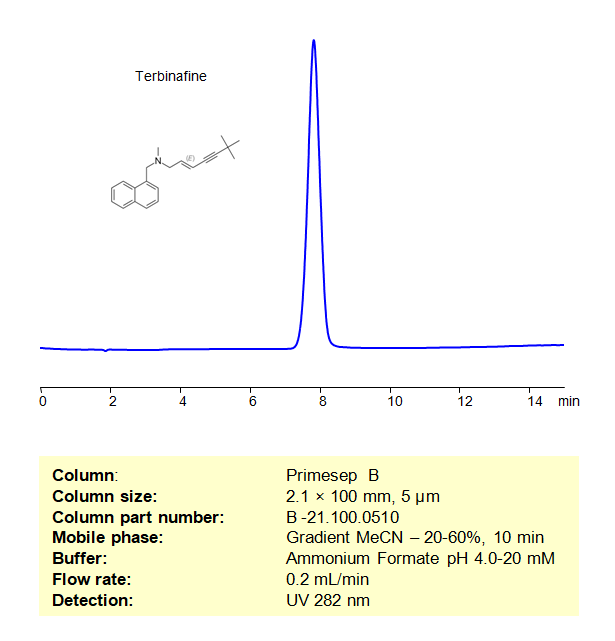
Terbinafin can be retained, and analyzed on a Primesep B mixed-mode stationary phase column using an isocratic analytical method with a simple mobile phase of water, Acetonitrile (MeCN), and a ammonium format a buffer. This analysis method can be detected in the UV 270 nm.
Method Parameters
| Mobile Phase | Gradient MeCN – 20-50%, 10 min |
|---|---|
| Buffer | Ammonium Formate pH 4.0-20 mM |
| Flow Rate | 0.2 ml/min |
| Detection | UV, 282 nm |
| Sample concentration | 0.5 mg/ml |
| Injection volume | 1 µl |
| LOD | 8 ppb |
| Class of Compounds | Allylamines |
| Analyzing Compounds | Terbinafine |