HPLC Method for Analysis of FD&C Yellow 5 (Tartrazine) in M&M’s on BIST A+ Column
https://sielc.com/hplc-method-for-analysis-of-tartrazine-candyChromatogram
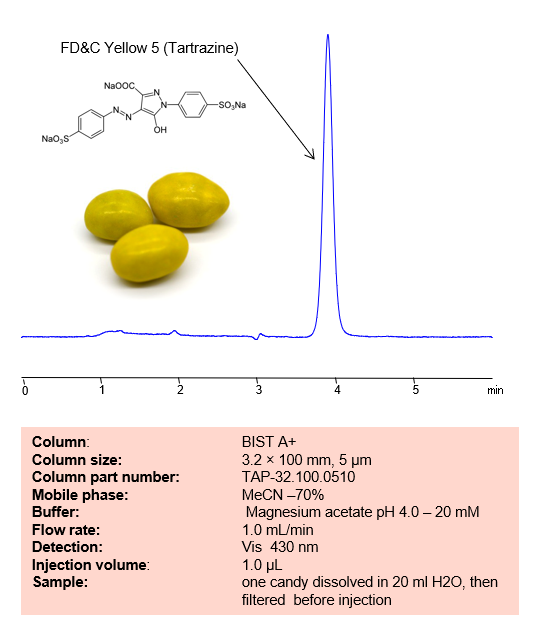
Description
· HPLC Method for Analysis of Tartrazine (FD&C Yellow 5) on BIST A+ by SIELC Technologies
Tartrazine is the most popular yellow synthetic dye in the world with the chemical formula C 16 H 9 N 4 Na 3 O 9 S 2 . It is used in a multitude of food, cosmetic products, and medications. It is one of the oldest known members of the pyrazolone family of dyes. You can find detailed UV spectra of Tartrazine (FD&C Yellow 5) and information about its various lambda maxima by visiting the following link.
Using SIELC’s newly introduced BIST™ method, tartrazine, which dissolves and ionizes in water, can be retained on a negatively-charged, cation-exchange BIST A+ column. There are two keys to this retention method: 1) a multi-charged, positive buffer, such as Magnesium acetate (Mg(AcO)2), which acts as a bridge, linking the negatively charged dye to the negatively-charged column surface and 2) a mobile phase consisting mostly of organic solvent (such as MeCN) to minimize the formation of a solvation layer around the charged analytes. Using this new and unique analysis method, Tartrazine can be separated, retained, and UV detected at 430 nm.
To extract the dye from the candy, place a colored sugar-coated chocolate candy in a beaker filled with about 20 mL of water. Once the dye is dissolved into the water, fill a syringe with the water and then place a filter at the end of the syringe. Depress the plunger and fill a new clean vial with the extracted dye. The Tartrazine is now ready to be analyzed.
Method Parameters
| Mobile Phase | MeCN – 70% |
|---|---|
| Buffer | Magnesium Acetate pH 4.0 – 20 mM |
| Flow Rate | 0.5 ml/min |
| Detection | Vis 430 nm |
| Class of Compounds | Acid, Dye |
| Analyzing Compounds | Tartrazine (FD&C Yellow 5) |