HPLC Method for Analysis of Sucrose hexasulfate on BIST A+ Column
https://sielc.com/hplc-method-for-analysis-of-sucrose-hexasulfateChromatogram
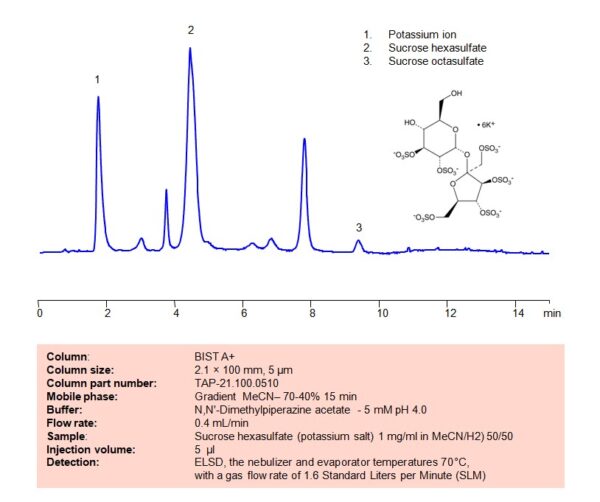
Description
· HPLC Method for Analysis of Sucrose Hexasulfate on BIST A+ Column by SIELC Technologies
Sucrose hexasulfate is a chemically modified form of sucrose with the chemical formula C 12 H 16 K 6 O 29 S 6 . Six of the hydroxyl groups in the sucrose molecule are replaced with sulfate groups. This modification significantly alters the properties of the original sugar molecule.
Using SIELC’s newly introduced BIST™ method, Sucrose Hexasulfate can be retained on a negatively-charged, cation-exchange BIST A+ column. There are two keys to this retention method: 1) a multi-charged, positive buffer, such as DMP acetate, which acts as a bridge, linking the negatively charged dye to the negatively-charged column surface and 2) a mobile phase consisting mostly of organic solvent (such as MeCN) to minimize the formation of a solvation layer around the charged analytes. Using this new and unique analysis method, oligonucleotide can be separated, retained, and detected at ELSD
Method Parameters
| Mobile Phase | Gradienr MeCN – 70-40%, 15 min |
|---|---|
| Buffer | DMP acetate pH 4.0 – 5 mM |
| Flow Rate | 0.4 ml/min |
| Detection | ELSD, the nebulizer and evaporator temperatures 70°C,with a gas flow rate of 1.6 Standard Liters per Minute (SLM |
| Sample | 1 mg/ml in MeCN/H2O – 50/50% |
| Injection volume | 5 µl |
| Class of Compounds | Sulfated polysaccharides |
| Analyzing Compounds | Sucrose Hexasulfate |