HPLC- MS Method for Analysis of Ketamine on Primesep 100 Column
https://sielc.com/hplc-method-for-analysis-of-ketamine-msChromatogram
Description
· HPLC Method for Analysis of Ketamine on Primesep 100 Column by SIELC Technologies
Ketamine , also known as (RS)-2-(2-chlorophenyl)-2-(methylamino)cyclohexanone , is a medication with the chemical formula C 13 H 16 ClNO . It is primarily used for induction and maintenance of anesthesia in both humans and animals. It is classified as an arylcyclohexylamine. It also has analgesic and sedative properties. It has a unique mechanism of action, acting primarily as an antagonist of the N-methyl-D-aspartate (NMDA) receptor, which is involved in pain transmission and synaptic plasticity. Beyond its primary anesthetic use, ketamine has also been investigated for its rapid-acting antidepressant effects and is used in certain treatment-resistant cases of depression. Due to its potential for misuse and the hallucinogenic effects it can produce at sub-anesthetic doses, ketamine is also classified as a controlled substance in many countries. You can find detailed UV spectra of Ketamine and information about its various lambda maxima by visiting the following link.
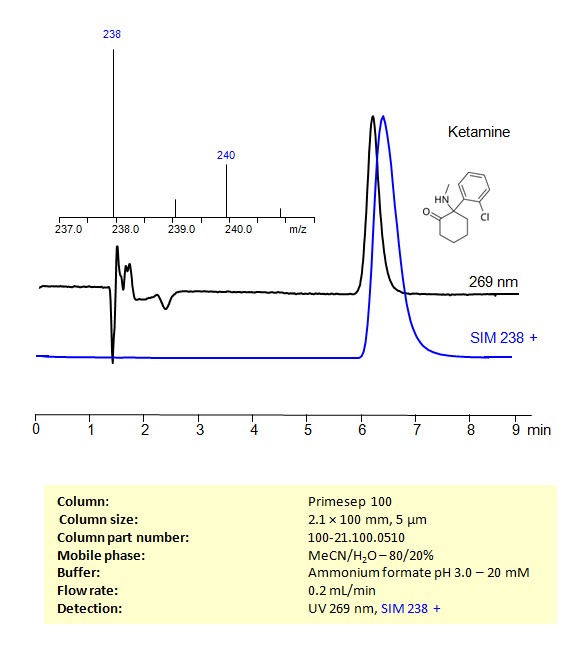
Ketamine can be retained, and analyzed on a Primesep 100 mixed-mode stationary phase column using an isocratic analytical method with a simple mobile phase of water, Acetonitrile (MeCN), and a ammonium format as a buffer. This analysis method can be detected using UV at 269 nm, an Evaporative Light Scattering Detector (ELSD), or any other evaporative detection method (CAD, ESI-MS)
Method Parameters
| Mobile Phase | MeCN – 80%, |
|---|---|
| Buffer | Ammonium Formate pH 3.0-20 mM |
| Flow Rate | 0.2 ml/min |
| Detection | UV, 269 nm, SIM 238 + |
| Spray Voltage: | 1.5 kV |
| Nebulizing gas: | 1.5 L/min |
| Drying gas: | 15 L/min |
| DL temp: | 250 ˚C |
| Heat Block: | 400 ˚C |
| Class of Compounds | Drug, arylcyclohexylamine |
| Analyzing Compounds | Ketamine |