HPLC Method for Analysis of Guanylurea on Primesep 100 Column
https://sielc.com/hplc-method-for-analysis-of-guanylureaChromatogram
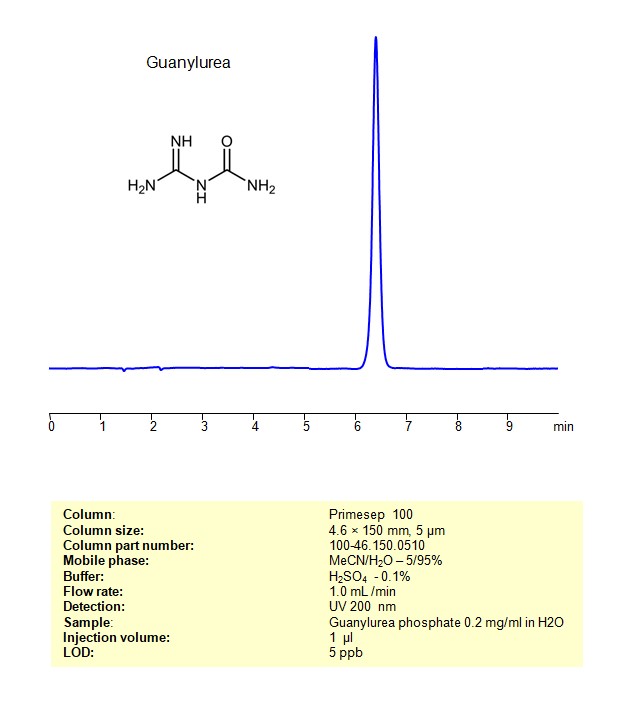
Description
· HPLC Method for Analysis of Guanylurea on Primesep 100 Column by SIELC Technologies
Guanylurea , also known as guanylurea phosphate or imidodicarbonimidic diamide, is a chemical compound with the formula C 2 H 6 N 4 O . It is derived from guanidine, a compound found in the urine of mammals, which is itself a derivative of urea.
The structure of guanylurea is characterized by a urea molecule (carbonyl group flanked by two amine groups) connected to an additional amine group. This structure imparts unique chemical properties to guanylurea, making it distinct from simpler urea.
Agriculture : Guanylurea can be used as a source of nitrogen in fertilizers, similar to urea. Its efficacy as a fertilizer comes from its ability to release nitrogen slowly into the soil, which can be beneficial for plant growth.
Chemical Synthesis : It may be used as an intermediate in the synthesis of other chemical compounds, particularly in pharmaceuticals and agrochemicals.
Research : In scientific research, guanylurea may be studied for its chemical properties and potential applications in various fields.
Guanylurea can be retained, and analyzed on a Primesep 100 mixed-mode stationary phase column using an isocratic analytical method with a simple mobile phase of water, Acetonitrile (MeCN), and a sulfuric acid as a buffer. This analysis method can be detected using UV at 200 nm.
Method Parameters
| Mobile Phase | MeCN/H2O – 5/95% |
|---|---|
| Buffer | H2SO4 -0.1% |
| Flow Rate | 1.0 ml/min |
| Detection | UV 200 nm |
| Sample | Guanylurea phosphate 0.2 mg/ml in H2O |
| Injection volume | 1 µl |
| LOD* | 5 ppb |
| Class of Compounds | Ureas |
| Analyzing Compounds | Guanylurea |