HPLC Method For Analysis Of Gadolinium-DOTA on Newcrom BH Column
https://sielc.com/hplc-method-for-analysis-of-gadolinium-dotaChromatogram
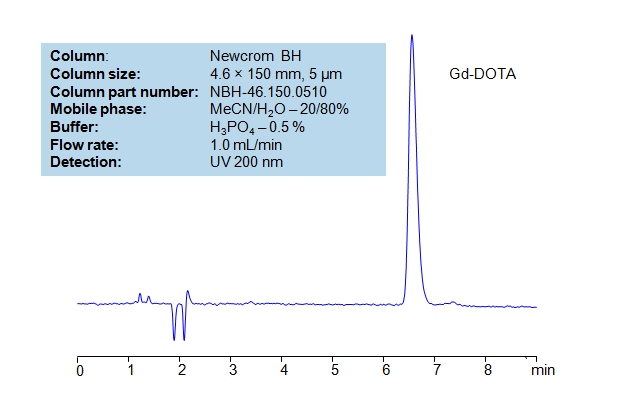
Description
· High Performance Liquid Chromatography (HPLC) Method for Analysis of Gadolinium-DOTA .
Gadolinium-DOTA , or known Gadoteric acid , is a well-known contrast agent with the chemical formula C 16 H 24 GdN 4 O 8 – . It is used primarily for for imaging of (often leaky) blood vessels, the brain, and spine. It’s composed of dodecane tetraacetic acid, or DOTA, with a Gadolinium III cation in the center. Due to its unique structure, this acidic compound has paramagnetic properties; when exposed to a magnetic field, it develops a magnetic moment, which can be utilized for magnetism-based imaging like MRI and NMR. Gadolinium-DOTA acts as a signal amplifier, thus appearing brighter under MRI scans and highlighting the tissues that have absorbed it. In its salt form (with meglumine), it crosses the blood-brain barrier and allows for imaging of the brain and other areas of the nervous system. Due to its paramagnetic properties, Gadolinium-DOTA fluoresces; it excites at 274 nm and emits light at 312 nm. Gadolinium-DOTA can be retained and analyzed using the Newcrom BH stationary phase column. The analysis utilizes an isocratic method with a simple mobile phase consisting of water and acetonitrile (MeCN) with a phosphoric acid buffer. Detection is performed using UV.
Method Parameters
| Mobile Phase | MeCN/H2O – 20/80% |
|---|---|
| Buffer | H3PO4 – 0.5% |
| Flow Rate | 1.0 ml/min |
| Detection | UV, 200 nm |
| Class of Compounds | Acid |
| Analyzing Compounds | Gadolinium-DOTA |