HPLC Method for Analysis of Citric Acid and Potassium Bromide on Newcrom BH Column
https://sielc.com/hplc-method-for-analysis-of-citric-acid-and-potassium-bromideChromatogram
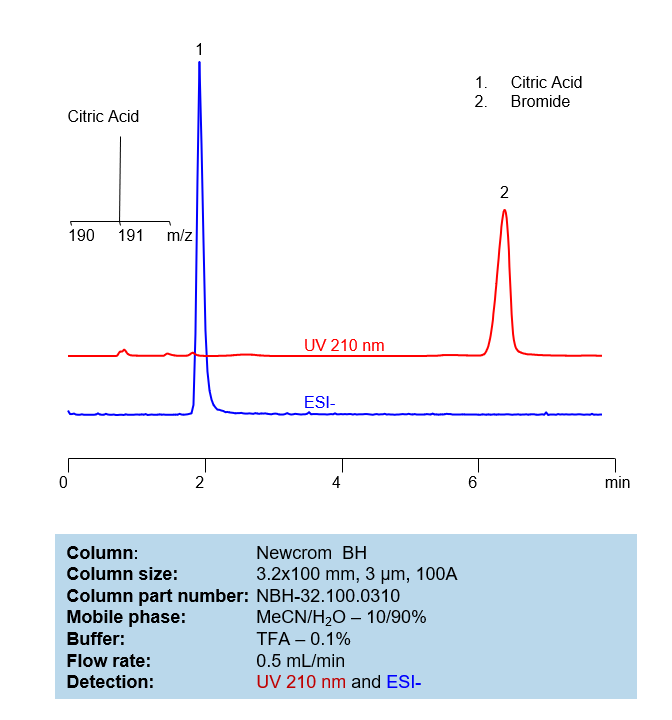
Description
High Performance Liquid Chromatography (HPLC) Method for Analysis of Citric Acid and Potassium Bromide
Citric Acid is a naturally occurring organic acid found in citrus fruits; it is also an intermediate in the citric acid cycle of aerobic organisms. It is used industrially as an acidity regulator, flavoring, detergent, and more than 2 million tons are produced annually. It’s chemical formula is C₆H₈O₇ . You can find detailed UV spectra of Citric Acid and information about its various lambda maxima by visiting the following link.
Potassium Bromide used to be a popular anticonvulsant and sedative with the chemical formula KBr . Now, it is mainly used as an antiepileptic medication for dogs. Sodium bromide tastes salty in any concentration, but the potassium ion gives a variety of tastes depending on the concentration. At lower concentration, it is sweet, but turns bitter at higher concentrations. If ingested as high concentration, it can cause strong irritation to the gastric mucous membrane and lead to vomiting. You can find detailed UV spectra of Citric Acid , Bromide and information about its various lambda maxima by visiting the following link.
Citric Acid , Bromide can be retained, separated, and analyzed on a mixed-mode Newcrom BH column with a mobile phase consisting of water, Acetonitrile (MeCN), and Trifluoroacetic acid (TFA). This analytical method can be UV detected at 210 nm with high resolution and peak symmetry. This method is also compatible with Mass Spectrometry (MS), ELSD, and CAD. The Citric acid was detected via negative Electrospray Ionization (ESI-) at an m/z of 191.
Method Parameters
| Mobile Phase | MeCN – 10% |
|---|---|
| Buffer | TFA – 0.1% |
| Flow Rate | 0.5 ml/min |
| Detection | UV 210 nm, ESI |
| Class of Compounds | Acid |
| Analyzing Compounds | Citric Acid,Bromide |