HPLC Method for Analysis of Metformin on Primesep 100 Column
https://sielc.com/hplc-method-for-analysis-metforminChromatogram
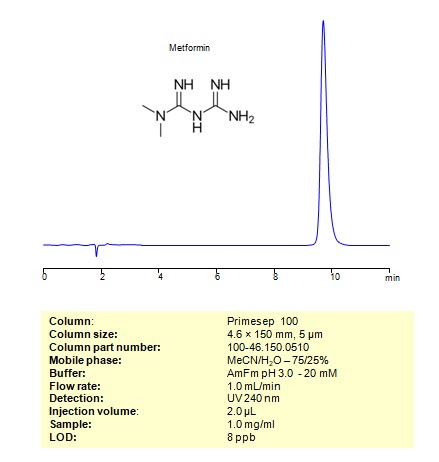
Description
· HPLC Method for Analysis of Metformin on Primesep 100 Column by SIELC Technologies
Biguanides, including Moroxydine, Metformin, Proguanil, and Phenformin, are a group of organic compounds that share a common structural feature, namely the presence of two guanidine groups.
Metformin is an oral antidiabetic medication with the chemical formula C 4 H 11 N 5 . It is primarily used to treat type 2 diabetes. It works by reducing glucose production in the liver and improving insulin sensitivity in peripheral tissues. Metformin is one of the most widely prescribed drugs for diabetes management. You can find detailed UV spectra of Metformin and information about its various lambda maxima by visiting the following link.
These biguanides exhibit various pharmacological activities, and while some are primarily used for antidiabetic purposes, others have applications in antiviral or antimalarial treatments. It’s important to note that the safety and efficacy of these drugs depend on proper medical supervision and adherence to prescribed dosages.
Metformin can be retained and analyzed using a Primesep 100 mixed-mode stationary phase column. The analysis employs an isocratic method with a simple mobile phase comprising water, acetonitrile (MeCN), and ammonium formate as a buffer. This method allows for detection using UV at 240 nm
Method Parameters
| Mobile Phase | MeCN/H2O 75/25% |
|---|---|
| Buffer | AmFm pH 3.0 – 30 mM |
| Flow Rate | 1.0 ml/min |
| Detection | UV 240 nm |
| Samples | 0.5 mg/ml |
| Injection volume | 2 µl |
| LOD* | 8 ppb |
| Class of Compounds | Biguanides |
| Analyzing Compounds | Metformin |