HPLC Method for Separation of Bile acids (Methyl cholate, Cholic acid, Deoxycholic acid, Chenodeoxycholic acid) on Primesep B Column
https://sielc.com/hplc-method-for-analysis-bile-acidsChromatogram
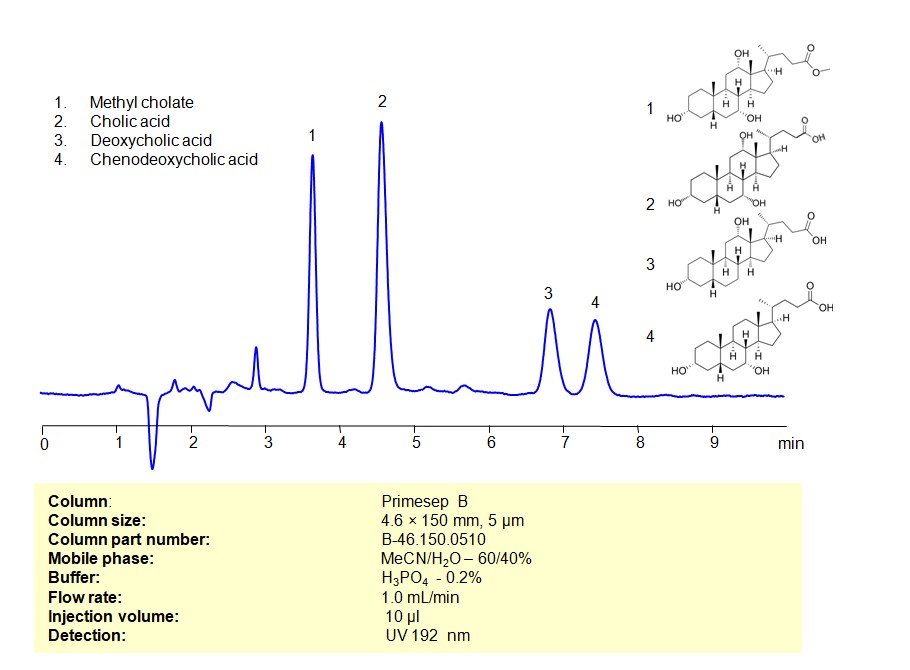
Description
HPLC Method for Analysis of Methyl cholate , Cholic acid , Deoxycholic acid , Chenodeoxycholic acid on Primesep B Column by SIELC Technologies
Bile acids are a class of amphipathic molecules derived from cholesterol that play a crucial role in the digestion and absorption of dietary fats. They are synthesized in the liver and released into the small intestine during digestion.
Cholic Acid is a primary bile acid with the chemical formula C 24 H 40 O 5 . It is synthesized in the liver from cholesterol and contributes to the emulsification and digestion of fats in the small intestine. As a medication, it is used to treat bile acid synthesis disorder, that is caused by defects of the single enzyme, as well as Zellweger syndrome.
Deoxycholic Acid is a secondary bile acid with the chemical formula C 24 H 40 O 4 . It is formed by bacterial action in the colon on cholic acid. Deoxycholic acid aids in the digestion and absorption of fats. In some countries it is even licensed to be used as an emulsifier in the food industry. It has found a lot of use in research focused on immunology, cancer, and nanotechnology.
Chenodeoxycholic Acid , also known as chenocholic acid, is a primary bile acid with the chemical formula C 24 H 40 O 4 . It is synthesized in the liver. It participates in the emulsification of fats. It has been used medically to dissolve gallstones, treat cerebrotendinous xanthomatosis, and constipation.
Methyl cholate is a compound with the chemical formula C 25 H 42 O 5 . Methyl cholate is derived from cholic acid, one of the primary bile acids. The addition of a methyl group to cholic acid results in the formation of methyl cholate. Bile acids, including methyl cholate, contribute to the solubilization of lipids.
These bile acids are part of the bile acid pool, which undergoes enterohepatic circulation—being released into the small intestine, reabsorbed in the terminal ileum, and returned to the liver. Bile acids also play a role in cholesterol metabolism and act as signaling molecules.
Method Parameters
| Mobile Phase | MeCN/H2O – 60/40% |
|---|---|
| Buffer | H3PO4 -0.2% |
| Flow Rate | 1.0 ml/min |
| Detection | UV 192 nm |
| Samples | 2 mg/mL in MeCN/H2O – 50/50% |
| Injection volume | 10 µl |
| LOD* | 0.2 ppm |
| Class of Compounds | bile acids |
| Analyzing Compounds | Methyl cholate,Cholic acid,Deoxycholic acid,Chenodeoxycholic acid |