HPLC Method for Analysis of Hymexazol (3-Hydroxy-5-methylisoxazole) on Primesep B Column
https://sielc.com/hplc-method-for-analysis-3-hydroxy-5-methylisoxazoleChromatogram
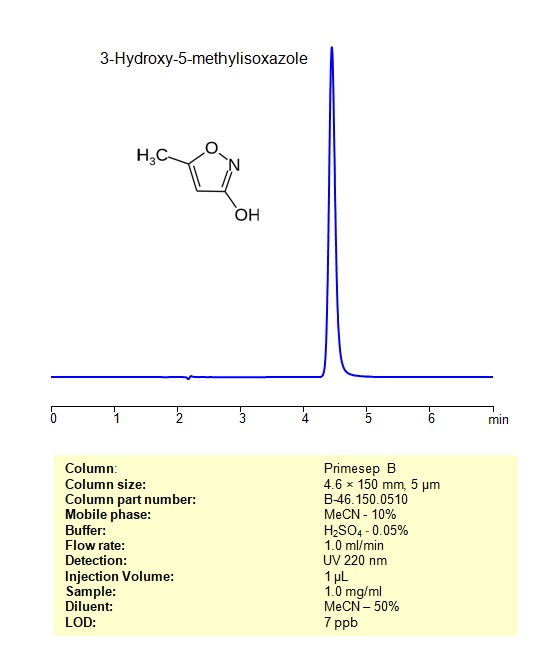
Description
Hymexazol is a fungicide with the chemical formula C 4 H 5 NO 2 . It is a part of the class of isoxazoles which carry hydroxy and methyl substituents at positions 3 and 5 respectively. It is used primarily as a fungicide to control diseases in rice, sugarbeet, ornamentals, vegetables, and more. It works through inhibiting the fungal RNA and DNA synthesis. You can find detailed UV spectra of Hymexazol and information about its various lambda maxima by visiting the following link.
Hymexazol can be retained and analyzed using a Primesep B mixed-mode stationary phase column. The analysis employs an isocratic method with a simple mobile phase comprising water, acetonitrile (MeCN), and sulfuric acid as a buffer. This method allows for detection using UV at 222 nm
Method Parameters
| Mobile Phase | MeCN/H2O – 10/90% |
|---|---|
| Buffer | H2SO4 – 0.05% |
| Flow Rate | 1.0 ml/min |
| Detection | UV 220 nm |
| Samples | 1.0 mg/ml in MeCN/H2O – 50/50% |
| Injection volume | 1 µl |
| LOD* | 7 ppb |
| Class of Compounds | Isoxazoles |
| Analyzing Compounds | Hymexazol |