HPLC Method for Analysis of Xanthurenic acid on Newcrom BH Column
https://sielc.com/hplc-determination-of-xanthurenic-acidChromatogram
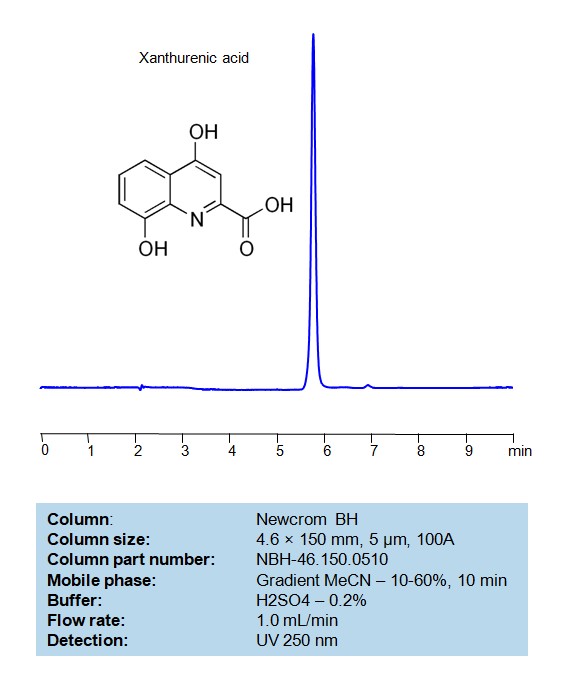
Description
Xanthurenic acid is a compound with the chemical formula C 10 H 7 NO 4 . It is associated with tryptophan metabolism and is known to be excreted in the urine. It is a non-essential, non-proteinogenic amino acid derivative and is considered to be a metabolite of tryptophan. It is part of the kynurenine pathway, which is the major catabolic route for tryptophan. Synthesis of xanthurenic acid is dependent on vitamin B6 (pyridoxal phosphate), as it is a cofactor for enzymes in the tryptophan degradation pathway.
Xanthurenic acid is characterized by the presence of two hydroxy groups and a carboxylic acid group. Structurally, it is composed of a bicyclic ring system that incorporates a benzene ring and a pyridine ring (with a nitrogen atom). The benzene ring is substituted with two hydroxy groups at positions 4 and 8, and the pyridine ring carries a carboxylic acid functionality. It is formed from 3-hydroxykynurenine by the action of the enzyme kynurenine 3-monooxygenase and can further be converted to 2-amino-3-carboxymuconate semialdehyde by xanthurenate 8-monooxygenase
Xanthurenic acid can be retained and analyzed on a mixed-mode Xanthurenic acid column with a mobile phase consisting of water, Acetonitrile (MeCN), and sulfuric acid. This analytical method can detect compounds with high resolution and peak symmetry using UV detection at 200 nm
Method Parameters
| Mobile Phase | Gradient MeCN – 10-60%, 10 min |
|---|---|
| Buffer | H2SO4 – 0.2% |
| Flow Rate | 1.0 ml/min |
| Peak Retention Time | 5.58 min |
| Detection | 250 nm |
| Class of Compounds | Acid |
| Analyzing Compounds | Xanthurenic acid |