HPLC Method for Separation of Rutin and Kaempferol on Newcrom R1 Column
https://sielc.com/hplc-determination-of-rutin-and-kaempferolChromatogram
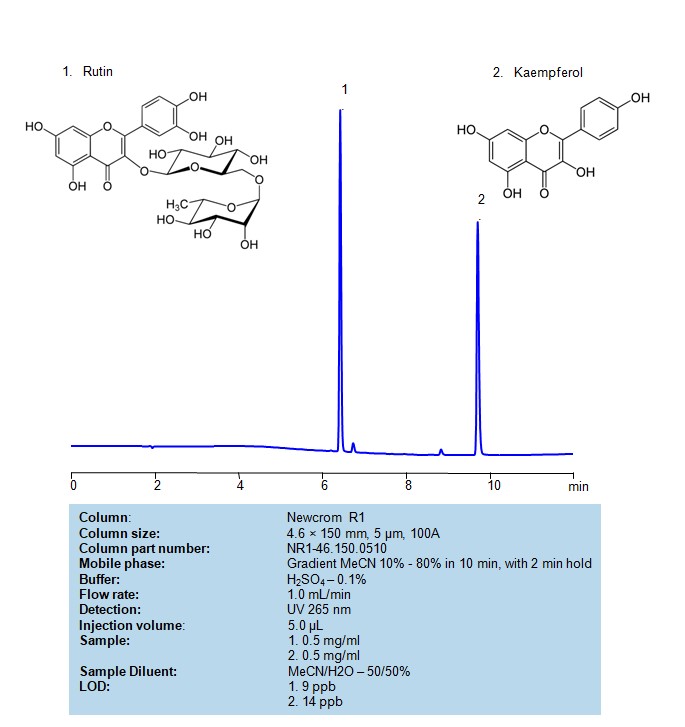
Description
· HPLC Method for Analysis of Rutin , Kaempferol on Newcrom R1 Column by SIELC Technologies
Rutin and kaempferol are both natural compounds found in various plants, particularly in fruits and vegetables. They belong to the class of flavonoids, which are a group of polyphenolic compounds known for their antioxidant properties and potential health benefits.
Rutin , also known as rutoside, quercetin-3-O-rutinoside, or vitamin P, is a glycoside of the flavonoid quercetin with the chemical formula C 27 H 30 O 16 . It consists of quercetin bound to the disaccharide rutinose. Rutin is found in various foods, including citrus fruits, apples, berries, buckwheat, and green tea. It is known for its antioxidant properties and has been studied for potential benefits, such as supporting cardiovascular health, reducing inflammation, and promoting blood vessel health. You can find detailed UV spectra of Rutin and information about its various lambda maxima by visiting the following link.
Kaempferol is a flavonol, a subtype of flavonoids, with the chemical formula C 15 H 10 O 6 . Its chemical structure includes a flavone backbone with hydroxyl groups. Kaempferol is present in various fruits and vegetables, such as apples, berries, tomatoes, broccoli, tea, and onions. It is recognized for its antioxidant and anti-inflammatory properties. It has been studied for potential effects on reducing the risk of chronic diseases, including cardiovascular diseases and certain types of cancer. Additionally, it may have neuroprotective properties. You can find detailed UV spectra of Kaempferol and information about its various lambda maxima by visiting the following link.
Both rutin and kaempferol are considered bioactive compounds, and their presence in a balanced diet rich in fruits and vegetables is associated with potential health benefits.
Rutin , Kaempferol be retained, separated and analyzed on a reversed-phase Newcrom R1 column with a mobile phase consisting of water, Acetonitrile (MeCN), and sulfuric acid. This analytical method can be detected with high resolution and peak symmetry at a wavelength of 265 nm using UV detection
Method Parameters
| Mobile Phase | Gradient MeCN – 10-90%,10 min , 5 min hold |
|---|---|
| Buffer | H2SO4 – 0.1% |
| Flow Rate | 1.0 ml/min |
| Detection | UV 265 nm |
| Injection volume: | 5.0 µL |
| Sample | 1. 0.5 mg/ml2. 0.5 mg/ml |
| Sample Diluent | MeCN/H2O – 50/50% |
| LOD* | 1. 9 ppb2. 14 ppb |
| Class of Compounds | Flavonoids |
| Analyzing Compounds | Rutin,Kaempferol |