HPLC Determination of CBD, CBN, THC, 8-THC and THCA on Cannsep C Column
https://sielc.com/hplc-determination-of-cbd-cbn-thc-8-thc-and-thca-on-cannsep-c-columnChromatogram
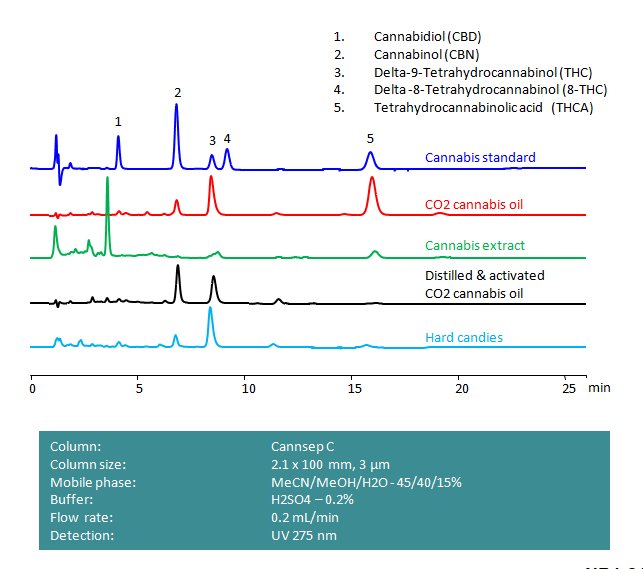
HPLC Determination of CBD, CBN, THC, 8-THC and THCA on Cannsep C Column
Description
· High Performance Liquid Chromatography (HPLC) Method for Analysis of CBD, CBN, THC, 8-THC and THCA.
Cannabidiol ( CBD ) is a phytocannabinoid with the chemical formula C 21 H 30 O 2 . It is used in a variety of ways. It’s only confirmed medical use is as epilepsy medication. It may help with pain, sleep, and addiction as an alternative to opioids, but due to limited clinical evidence, it’s regulations are dependent on the state. It is advised against using it during pregnancy due to unknown effects on fetal and infant development.
Cannabinol ( CBN ) is a mildly psychoactive phytocannabinoid with the chemical formula C 21 H 26 O 2 . It was the first cannabinoid to be isolated from cannabis in the late 1800s. It is legal in the United States as long as the THC concentration is 0.3% or less.
Delta-9-Tetrahydrocannabinol , also known as delta-9-THC and Δ 9 -THC, or simply THC , is the principal psychoactive constituent of Cannabis with the chemical formula C 21 H 30 O 2 . In pharmaceutical contexts, it is referred to as dronabinol and is used un nabiximols, which helps alleviate neuropathic pain, spasticity, overactive bladder, and more. Medical use of THC is allowed in the majority of the states in the United States of America, with less than half having it be legal for recreational use.
Delta-8-Tetrahydrocannabinol , also known as delta-8-THC and Δ 8 -THC, is a sychoactive cannabinoid with the chemical formula C 21 H 30 O 2 . It is less potent than delta-9-THC, it works in a similar way by binding to cannabinoid receptors in the brain. It’s legality is dependent on the state.
Tetrahydrocannabinolic acid ( THCA ), also known as conjugate base tetrahydrocannabinolate, is a precursor of Tetrahydrocannabinol with the chemical formula C 22 H 30 O 4 . Findings in regards to it being anything besides the THC precursor are limited, nor is it scheduled at the federal level in the United States, but it may be considered an analog of THC, leading to a risk if possessing or selling it.
Δ8-THC, Δ9-THC, CBD, THCA and CBN are cannabinoids found in Cannabis plants. They have some medical uses among which is the prevention of nausea and vomiting caused by some cancer medications. They can be separated using HPLC on a reverse-phase Cannsep C column using a mobile phase consisting of methanol (MeOH), Acetonitrile (MeCN, ACN), and water with sulfuric acid (H2SO4) as buffer and UV detected at 210nm.
Method Parameters
| Mobile Phase | MeCN/MeOH/H2O – 45/40/15% |
|---|---|
| Buffer | H2SO4 – 0.2% |
| Flow Rate | 0.2 ml/min |
| Detection | UV, 200 nm |
| Class of Compounds | Drug, Hydrophilic, Ionizable, Supplements |
| Analyzing Compounds | Cannabidiol (CBD),Cannabinol (CBN),Tetrahydrocannabinol (THC),Delta-8-Tetrahydrocannabinol (8-THC),Delta-9-Tetrahydrocannabinol (THC),Tetrahydrocannabinolic acid (THCA-A) |