HPLC Method for Analysis of Iron (III) in FeCl3 on Primesep N (Coated) Column
https://sielc.com/hplc-analysis-of-ironChromatogram
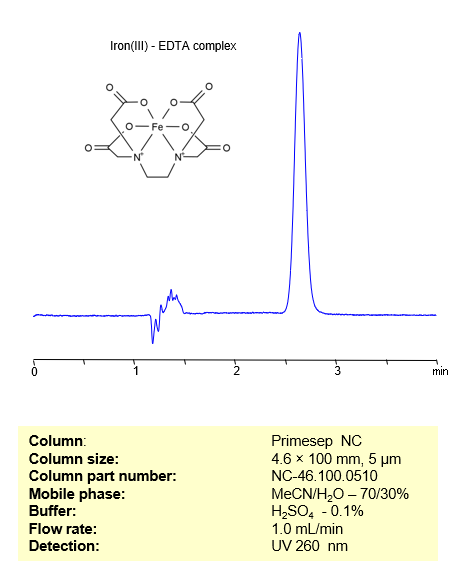
Description
· Separation type: Hydrophilic interaction liquid chromatography (HILIC) · HPLC Method for Analysis of Iron (III) in FeCl3 on Primesep NC Column
The analysis of Fe3+ involves various analytical methods such as colorimetric methods, atomic absorption spectroscopy (AAS), inductively coupled plasma optical emission spectrometry (ICP-OES), and high-performance liquid chromatography (HPLC). Within the realm of HPLC, specific techniques like ion chromatography or chelation chromatography are often employed to separate Fe3+ ions. Post-separation, UV-visible detectors or post-column derivatization with appropriate reagents can be used for detection and quantification of Fe3+ ions.
To overcome these complexities, SIELC has developed a novel, selective methodology, offering a straightforward and reliable approach for Fe(III) quantitation in various liquid samples. This method revolves around the formation of a complex with EDTA, which exhibits strong UV light absorption with peak maxima at 260 nm
EDTA Standards Solution A
For the preparation of the Disodium Dihydrogen Ethylenediaminetetraacetate Dihydrate (EDTA disodium salt) standard solution, 20 mg of EDTA was accurately weighed and transferred into a 10 mL volumetric flask and dissolved in water with sonication or magnetic stirrer mixing. Filtered The EDTA stock solution (2000 ppm) should be stored in a cold dark place and can be used for a week to prepare standards of required concentration. Iron(III) chloride Solution B The standard stock solution of Iron(III) chloride (100 ppm Fe3+) was prepared in water. 48 mg of Iron(III) chloride hexahydrate was accurately weighed and transferred into a 100 mL volumetric flask and dissolved in water and sonicated if needed. General procedure for Iron(III) – EDTA complex analysis Mix 100 µL Solution A , 200 µL Solution B , and 700 µL of water. Place this mixture in a plastic HPLC vial for analysis.
LOD was determined for this combination of instrument, method, and analyte, and it can vary from one laboratory to another even when the same general type of analysis is being performed.
Method Parameters
| Mobile Phase | MeCN/H2O -70/30% |
|---|---|
| Buffer | H2SO4 – 0.1% |
| Flow Rate | 1.0 ml/min |
| Detection | UV 260 nm |
| Peak Retention Time | 2.8 min |
| Sample concentration | 100 ppm |
| Injection volume | 10 µl |
| Sample diluent | H2O + NaOH |
| LOD | 1 ppm |
| Class of Compounds | Ion, Metal |
| Analyzing Compounds | Iron(III) |