HPLC Method for the Analysis of Glycerol Following Chemical Derivatization on Primesep 100 Column
https://sielc.com/hplc-analysis-of-glycerol-post-derivatization-ps-100Chromatogram
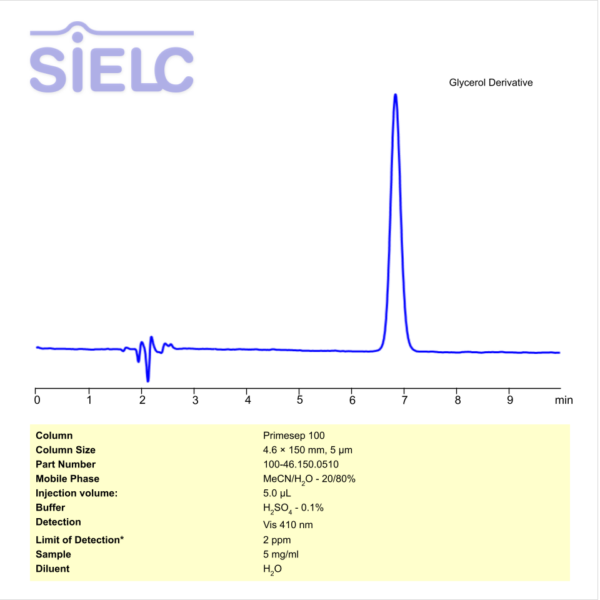
Description
· High Performance Liquid Chromatography (HPLC) Method for Analysis of Glycerol
Glycerol is an organic compound with the molecular formula C 3 H 8 O 3 . It is a humectant, solvent, and sweetener that used in various industries including skin care, hygiene products, pharmaceuticals, and food. It is said to improve lubrication and smoothness in products. Historically, before ethylene glycol took over, glycerol was used as a antifreeze. There is no Uv-Vis absorption found with standard Glycerol.
This derivatization was done using two reagents:
Reagent A (Periodate reagent): 6.5mg NaIO4 in 9mL of water, 1mL acetic acid, and 0.77g ammonium acetate
Reagent B (Acetylacetone reagent): 0.25mL of Acetylacetone in 24.75mL of isopropanol.
The sample was created by adding 0.2mL of Reagent A to 0.5mL hydrolysate and mixing for 5 minutes at room temperature. Afterwards, 0.5 mL of Reagent B was added to the solution and mixed for 20 minutes.
Glycerol can be retained and analyzed using the Primesep 100 stationary phase column. The analysis utilizes an isocratic method with a simple mobile phase consisting of water and acetonitrile (MeCN) with a sulfuric acid buffer. Detection is performed using UV.
Method Parameters
| Mobile Phase | MeCN – 20% |
|---|---|
| Buffer | H2SO4 – 0.1% |
| Flow Rate | 1.0 ml/min |
| Detection | Vis 410 |
| Limit of Detection* | 2 ppm |
| Class of Compounds | Sugar |
| Analyzing Compounds | Glycerol |