HPLC Separation of Inorganic Anions on Newcrom BH Column
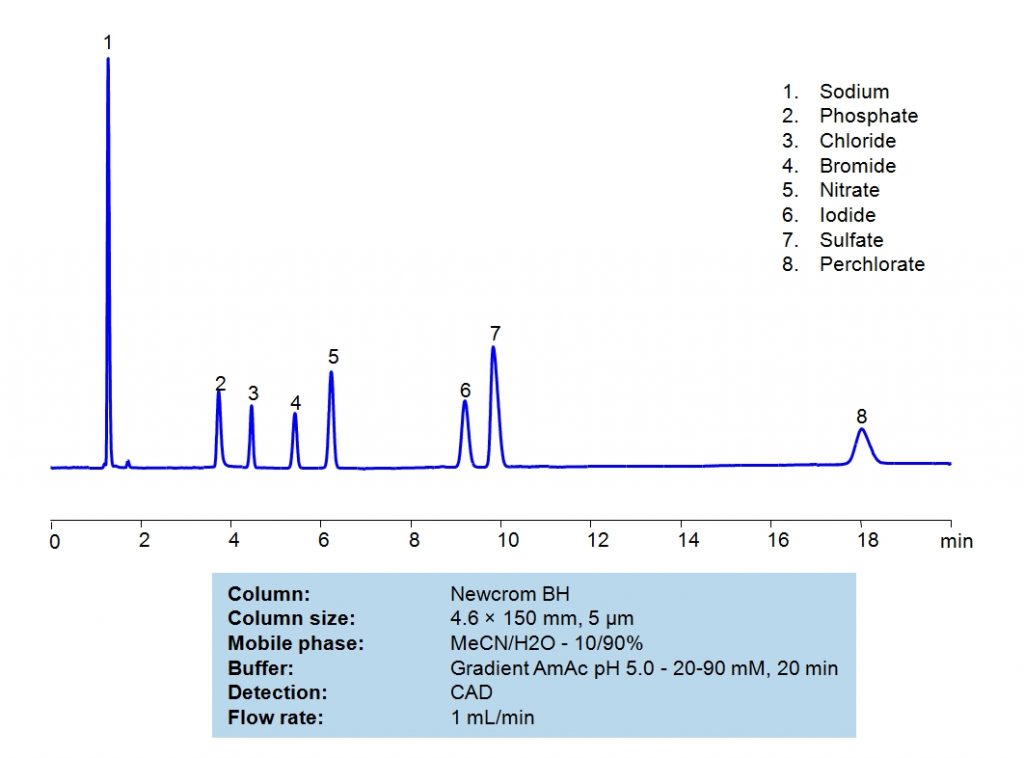
High Performance Liquid Chromatography (HPLC) Method for Analysis of Sodium , Phosphate , Chloride , Bromide , Nitrate , Sulfate , Iodine , Perchlorate , Iodide
Sodium , which has a chemical symbol of Na , is a soft alkali metal that is highly reactive. It is found in abundance in everyday materials like table salt, sea water, and even the Earth’s crust. It is crucial for the body’s function and fluid balance.
Phosphate, PO 4 3- , is a compound that plays an important part in biological energy transfer. It contains phosphorus, which is also a key component in bones and teeth. It is also a buffer, which helps maintain pH levels in a body.
Chloride is typically used to refer to a compound or molecule that contains a chlorine anion: Cl – . It is an electrolyte that is essential for bodily functions including blood pH, fluid balance, cellular functions, and more. Imbalance of chloride can indicate underlying health problems.
Bromide is typically used to refer to a compound or molecule that contains a bromide anion: Br – . It is often found in anticonvulsants, flame-retardant materials, and cell stains.
Nitrate, NO 3 – , is a compound of nitrogen and oxygen. It is essential as a nutrient in plants; therefore, it is often used in fertilizers. It is easily found in leafy greens. While it is important for cardiovascular health, too high of exposure to it can be dangerous.
Methodenparameter
| Column | Newcrom BH, 4.6 x 150 mm, 5 µm, 100 Å, dual ended |
|---|---|
| Mobile Phase | MeCN/H2O – 10/90% |
| Buffer | Gradient AmAc pH 5.0 – 20-90 mM , 20 min |
| Flow Rate | 1.0 mL/min |
| Detection | CAD (Corona) (MS-compatible mobile phase) |