HPLC Separation of Adenosine and Deoxyadenosine on Newcrom AH Column
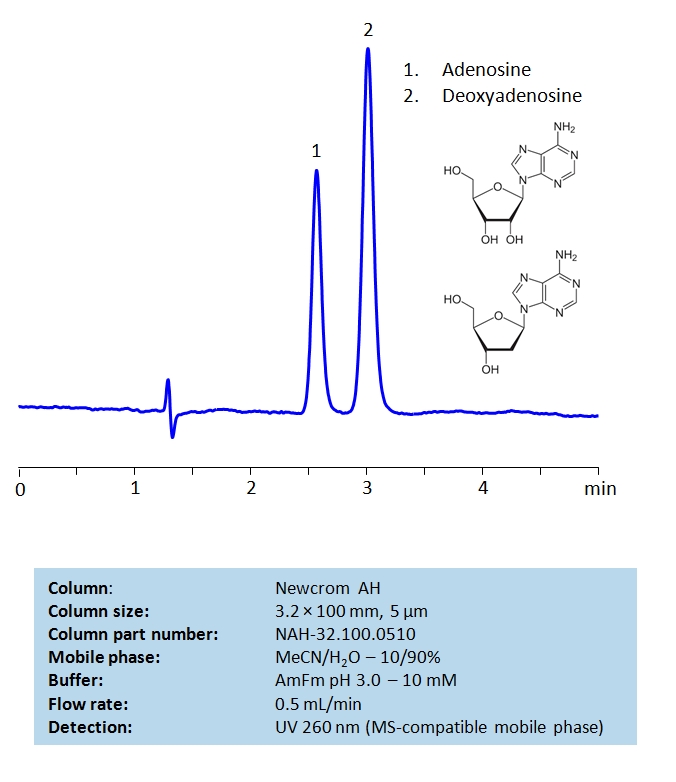
High Performance Liquid Chromatography (HPLC) Method of Adenosine and Deoxyadenosine.
Adenosine is a key building block of energy-carrying molecules with the chemical formula C10H13N5O4 . It has a variety of other uses, including being a inhibitory neurotransmitter which helps with sleep and acting as a blood flow regulator. Medicinally, it is used as treatment for supraventricular tachycardia (SVT). You can find detailed UV spectra of Adenosine and information about its various lambda maxima by visiting the following link.
Deoxyadenosine is a deoxyribonucleoside with the chemical formula C10H13N5O3 . It is a derivative of adenosine. High presence of it can kill T lymphocytes and kill those cells, leading to adenosine deaminase severe combined immunodeficiency disease, also known as ADA-SCID.
Deoxyadenosine , Adenosine are the building blocks for DNA and RNA as well as other roles in biomechanical processes such as signal transduction. By using a Newcrom AH mixed-mode column with a cation-exchange mechanism, nucleosides: adenosine and deoxyadenosine, can be baseline separated in a short time using an isocratic method with a simple mobile phase of water, acetonitrile (MeCN, ACN), and ammonium formate (AmFm) buffer. Detection can be achieved with UV 260 nm, mass spectrometry (MS), evaporative light scattering detection (ELSD) and Charged aerosol detection (CAD).
Methodenparameter
| Column | Newcrom AH, 3.2 x 100 mm, 5 µm, 100 Å, dual ended |
|---|---|
| Mobile Phase | MeCN/H2O – 10/90% |
| Buffer | AmFm pH 3.0 – 10 mM |
| Flow Rate | 1.0 mL/min |
| Detection | UV, 260 nm |